

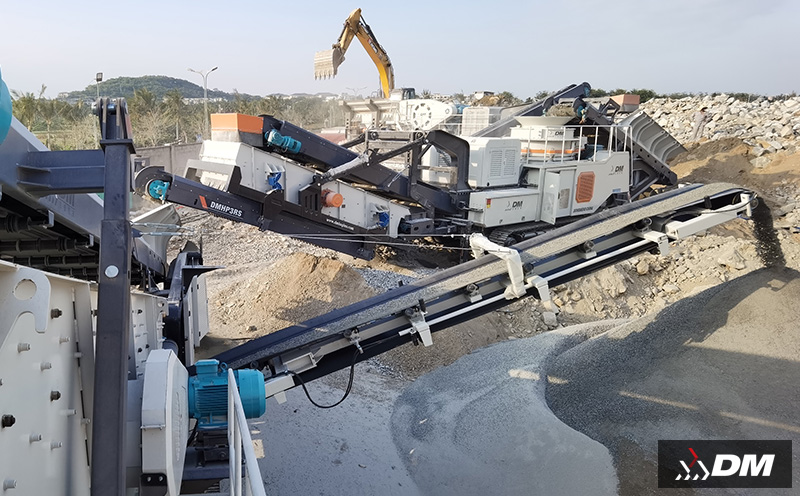
A mobile crusher, also referred to as a portable crushing station or mobile crushing module, is a compact, all-in-one crushing solution that integrates material feeding, crushing, screening, and conveying into a single movable unit. Unlike conventional stationary crushing setups, it removes the need for time-consuming foundation building and permanent installation work. Its on-the-go design allows for easy relocation to match dynamic construction schedules, making it a staple in construction debris recycling, quarrying operations, rural road construction projects, and commercial sand and gravel production. As a pivotal piece of equipment in contemporary engineering crushing tasks, it delivers unmatched flexibility alongside high operational efficiency.
1. Core Structure and Components of a Mobile Crusher
Built around a rugged towable chassis, the mobile crusher integrates critical components including the main crushing mechanism, material feeder, vibrating screen assembly, conveyor system, power unit, and control panel. Configurations vary by model to address specific operational demands:
- Main Crushing Unit: The central operational component. Depending on the hardness and texture of the material being processed, operators can select jaw crushers (for primary crushing), cone crushers (for secondary/tertiary crushing), impact crushers (for medium-hard materials), or vertical shaft impact (VSI) crushers (specialized for sand production);
- Feeding System: Generally equipped with a vibrating feeder to maintain a steady, consistent flow of raw material, which prevents overloading and premature wear of the main crushing unit;
- Screening and Conveying System: The vibrating screen sorts materials by particle size grade, while heavy-duty conveyor belts transport finished products of varying specifications to pre-designated stockpiles, creating a streamlined "crushing-screening-discharging" cycle;
- Power and Travel System: Powered by either a fuel-efficient diesel engine or an electric motor to suit on-site power availability. The chassis is fitted with either rubber tire or steel crawler tracks—tire-mounted units work best on flat, paved surfaces, while crawler units excel in muddy, uneven, or remote terrain.
2. Key Advantages of Mobile Crushers
When compared to fixed crushing production lines, mobile crushers stand out for three core benefits: operational flexibility, cost efficiency, and environmental adaptability:
- Enhanced Mobility and Easy Relocation: No disassembly or reassembly is needed; the unit can be towed directly or self-propelled to the worksite. This makes it ideal for scattered construction waste processing sites, remote quarry locations, and short-term engineering projects, cutting material transportation costs by up to 40%;
- Foundation-Free Installation, Rapid Startup: Eliminates the need for excavation and concrete foundation work required for fixed crushers. It can be operational within hours of arriving on-site (once power is connected), reducing project setup time and boosting capital utilization efficiency;
- Superior Adaptability to Harsh Working Conditions: Crawler-type mobile crushers feature exceptional off-road performance, suitable for mountainous regions, wetland areas, building demolition sites, and other challenging environments. They also allow for real-time adjustment of crushing parameters to match material hardness and desired output volume;
- Energy Efficiency and Environmental Compliance: Modern mobile crushers are fitted with low-power-consumption drive systems, dust collection hoods, and noise reduction enclosures. These features meet strict local environmental emission standards and prevent costly shutdowns due to regulatory violations.
3. Main Types and Application Scenarios of Mobile Crushers
Mobile crushers are classified by their mobility type and functional design to meet diverse industry needs:
- Tire-type Mobile Crushers: Cost-effective and quick to deploy, ideal for centralized material processing sites with flat terrain (e.g., urban construction waste recycling centers, temporary sand and gravel supplementation for road projects, highway maintenance and repair work);
- Crawler-type Mobile Crushers: Exceptional traction and stability, designed for use in complex terrains such as open-pit mines, hydropower dam construction sites, and mountainous infrastructure projects—capable of processing hard rock materials including granite, basalt, and quartz;
- Modular Mobile Crushing Plants: Composed of multiple interconnected mobile crushing units (e.g., primary crusher module + secondary/tertiary crusher module + sand-making module), forming a complete production chain to meet large-scale, multi-grade finished product requirements for commercial aggregate production.
In practical applications, impact-type mobile crushers are the top choice for construction waste processing, as they achieve both crushing and particle shaping in one step; jaw + cone crusher combinations are preferred for hard rock quarrying; VSI mobile crushers are customized for sand-making projects to produce high-quality construction-grade manufactured sand that meets national building standards.
4. Considerations for Purchasing and Using Mobile Crushers
When investing in a mobile crusher, it is crucial to evaluate your specific operational needs comprehensively:
- Select the main crushing unit based on material hardness (e.g., jaw + cone combinations for ultra-hard rock with compressive strength >300MPa, impact crushers for soft rock or construction waste with compressive strength <180MPa);
- Prioritize manufacturers with reliable wear part supply and nationwide after-sales service networks to minimize downtime and long-term maintenance costs;
- Choose between diesel and electric power, as well as tire or crawler tracks, based on on-site power access and terrain characteristics (e.g., electric for grid-connected sites, diesel for remote locations);
- During operation, conduct regular inspections of wear parts (e.g., jaw plates, hammer heads) and tighten all mechanical connections to ensure stable operation and extend the equipment's service life by 20-30%.
5. Conclusion
Thanks to its unmatched flexibility, high efficiency, and robust adaptability, the mobile crusher has become a leading alternative to traditional fixed crushing equipment. It plays an irreplaceable role in sustainable construction waste recycling, eco-friendly mining development, and emergency infrastructure repair projects. As technological innovation advances, mobile crushers are evolving toward smart automation and green energy use—incorporating IoT remote monitoring and hybrid power systems—further boosting operational efficiency, lowering running costs, and meeting the diverse crushing needs of the mining, construction, and environmental protection industries.

What Are the Three Core Types of Crushers and Their Industrial Uses?
Crushers are indispensable equipment across mining, civil engineering, and waste management sectors. Based on crushing mechanics, industry applications, and material properties, the three most widely used and versatile crusher types are jaw crushers, cone crushers, and impact crushers. These three types cover the full crushing process—from primary reduction to fine crushing and shaping—and form the backbone of sand, aggregate, and ore processing operations. Below is a detailed overview of their unique characteristics and optimal applications.
1. Jaw Crusher: The "Workhorse" for Primary Crushing
Also known as a "toggle jaw crusher," this is the oldest and most durable type of crushing equipment. It operates by applying compressive force to materials via the rhythmic opening and closing of a movable jaw plate against a fixed jaw plate, specializing in primary crushing—the initial size reduction stage of most material processing lines.
Core Features: Simple, rugged construction with a low failure rate and high compression resistance, capable of processing hard rocks with compressive strength up to 320 MPa (e.g., granite, basalt, iron ore). It features a large feed opening to accommodate oversized raw stones, and the discharge particle size can be easily adjusted by modifying the gap between the jaw plates.
Typical Applications: Primary crushing of raw mine ore, rough crushing of construction and demolition waste, initial processing of raw material for sand and gravel plants, and large stone reduction for highway and railway construction projects. It is particularly well-suited for harsh operating conditions that demand high equipment reliability.
2. Cone Crusher: The "Precision Tool" for Secondary/Tertiary Crushing
Utilizing the laminated crushing principle, the cone crusher uses the oscillating motion of a rotating mantle (movable cone) inside a concave (fixed cone) to squeeze, grind, and shear material that has already undergone primary crushing. As the primary equipment for secondary and tertiary crushing, it is available in spring-mounted and hydraulic variants.
Core Features: High crushing ratio, uniform finished particle size, and minimal needle-shaped or flaky particles. It is significantly more efficient than other crusher types when processing hard, abrasive materials. Hydraulic models offer automatic overload protection and cavity clearing, reducing maintenance costs and meeting the demands of large-scale, high-precision crushing operations (suitable for materials with compressive strength up to 300 MPa).
Typical Applications: Fine crushing of metallic ore, production of high-grade aggregate for highway and bridge construction, and manufacturing of concrete-grade crushed stone. It is commonly paired with jaw crushers to create the industry-standard "primary + secondary/tertiary crushing" production line.
3. Impact Crusher: The "Versatile Shaper" for Secondary Crushing
The impact crusher reduces material by means of a high-speed rotating rotor that drives hammer bars to strike the feed material, while the material also collides repeatedly with impact plates. It combines both crushing and particle shaping functions, focusing on secondary crushing and finished product optimization.
Core Features: Produces high-quality cubic-shaped finished particles (with minimal needle/flaky content), has a medium-sized feed inlet, and low energy consumption during operation. It is ideal for processing medium-soft rocks with compressive strength ≤ 180 MPa (e.g., limestone, dolomite, recycled construction waste).
Typical Applications: Resource recovery of construction and demolition waste, production of subbase aggregate for road construction, and shaping of raw material for manufactured sand. It is widely used in the building materials and municipal engineering sectors, especially in projects requiring premium particle shape for finished aggregate.
Comparison of Core Parameters of the Three Crusher Types
| Type | Crushing Principle | Applicable Material Hardness | Core Application Stage | Finished Particle Shape |
|---|---|---|---|---|
| Jaw Crusher | Compressive Crushing | High (≤320MPa) | Primary Crushing | General, Angular |
| Cone Crusher | Laminated Crushing | High (≤300MPa) | Secondary/Tertiary Crushing | Excellent, Uniform |
| Impact Crusher | Impact Crushing | Medium-Low (≤180MPa) | Secondary Crushing/Shaping | Superior, Cubic |
Key Selection Criteria: Align with Operational Needs
When selecting a crusher type, it is essential to match the equipment to your specific operational scenario:
- For processing large volumes of hard rock requiring only primary size reduction, jaw crushers are the optimal choice;
- For high-output fine crushing of hard rock with strict particle size uniformity requirements, cone crushers are the first option;
- For processing medium-soft materials where finished particle shape is a priority, impact crushers are the most suitable solution.
In real-world production setups, jaw crushers are frequently combined with cone or impact crushers to create a complete crushing process—from raw material intake to finished product—catering to the diverse processing needs of mining, construction, and waste management industries.
Conclusion
As the three fundamental crusher types, jaw, cone, and impact crushers each fulfill distinct roles in the crushing process: primary reduction, secondary/tertiary fine crushing, and secondary crushing/shaping. Together, they form the foundation of modern crushing production lines. Understanding their unique characteristics and application scenarios allows for precise equipment selection that aligns with production goals, improving crushing efficiency and reducing operational costs—this is the key to optimal equipment investment in mining, infrastructure, and related industries.













We will answer your email shortly!