

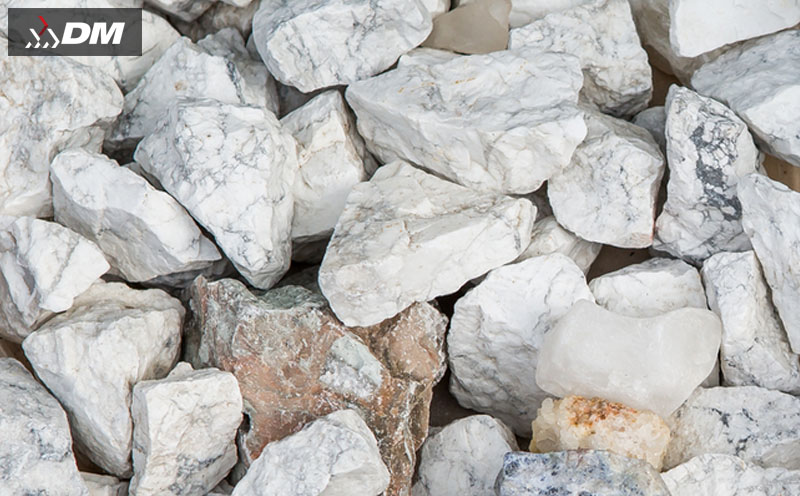
Dolomite is a common carbonate mineral (Mohs hardness 3.5-4.5, compressive strength 80-150MPa) with moderate hardness, good brittleness, and easy processing characteristics. It is widely used in building materials, metallurgical fluxes, chemical raw materials and other fields. The selection of suitable dolomite crushing equipment should be comprehensively determined based on its physical properties, finished product requirements and production scale. The following is an analysis of mainstream equipment for dolomite crushing and selection suggestions.
I. Core Equipment Types for Dolomite Crushing
1. Jaw Crusher (First Choice for Primary Crushing)
Working Principle: Crushing materials through periodic extrusion between moving and fixed jaws
Applicable Stage: Crushing raw ore (≤800mm) to 50-200mm
Core Advantages: - Large processing capacity (50-1500t/h), suitable for various dolomite raw materials - Simple structure, low failure rate, low maintenance cost - Strong adaptability to dolomite with high mud content
Limitations: Poor finished product shape, only used for primary crushing
2. Impact Crusher (Main Equipment for Medium and Fine Crushing)
Working Principle: Crushing materials by impact of high-speed rotating blow bars and rebound
Applicable Stage: Crushing 50-200mm materials to 5-50mm
Core Advantages: - Good finished product shape (high cubic content, needle-like particles ≤10%) - Large crushing ratio (1:15-1:25), which can simplify the crushing process - Easy adjustment, can quickly change the finished product size
Limitations: Blow bars wear quickly, service life is shortened when processing hard dolomite
3. Cone Crusher (High Capacity Fine Crushing)
Working Principle: Realizing fine crushing of materials through laminated extrusion
Applicable Stage: Crushing 50-150mm materials to 3-30mm
Core Advantages: - Large processing capacity (100-2000t/h), suitable for large-scale production - Long service life of wearing parts (2-3 times that of impact crushers) - Stable operation, suitable for continuous high-intensity operations
Limitations: Finished product shape is slightly inferior to impact crusher, higher equipment investment
4. Impact Sand Making Machine (Shaping and Sand Making)
Working Principle: Crushing through "stone-on-stone" and "stone-on-iron" methods
Applicable Stage: Crushing 10-50mm materials to 0-5mm sand
Core Advantages: - Reasonable gradation of finished products, excellent particle shape, meeting high standard sand requirements - Can produce various specifications of sand such as 0-3mm and 3-5mm - Suitable for dolomite artificial sand production
Limitations: Relatively small processing capacity (30-300t/h)
II. Equipment Performance Comparison and Application Scenarios
| Equipment Type | Processing Capacity | Finished Product Size | Particle Shape Quality | Wearing Parts Life | Investment Cost | Typical Applications |
|---|---|---|---|---|---|---|
| Jaw Crusher | 50-1500t/h | 50-200mm | General | 3-6 months | Medium-low | Primary crushing, various scale production lines |
| Impact Crusher | 30-800t/h | 5-50mm | Excellent | 1-3 months | Medium | Small and medium production lines, high particle shape requirements |
| Cone Crusher | 100-2000t/h | 3-30mm | Good | 4-8 months | High | Large production lines, high capacity requirements |
| Impact Sand Making Machine | 30-300t/h | 0-5mm | Excellent | 2-4 months | Medium-high | Artificial sand production, finished product shaping |
III. Typical Process Configuration Schemes
1. Construction Aggregate Production Line (0-5mm, 5-10mm, 10-20mm)
Configuration: Vibrating feeder + Jaw crusher + Impact crusher + Vibrating screen + Conveyor belt
Features: Moderate investment, good finished product shape, suitable for concrete mixing plants and construction projects
2. Large Metallurgical Flux Production Line (5-30mm)
Configuration: Heavy plate feeder + Jaw crusher + Cone crusher + Double layer vibrating screen
Features: Large capacity (500-1500t/h), stable operation, suitable for large iron and steel enterprises
3. Dolomite Sand Production Line (0-3mm, 3-5mm)
Configuration: Jaw crusher + Impact crusher + Impact sand making machine + Sand washer + Fine screen
Features: Reasonable gradation of finished products, high purity, suitable for glass, ceramics and other industries
4. Mobile Crushing Scheme
Configuration: Mobile jaw crushing station + Mobile impact crushing and screening station (combined operation)
Features: On-site crushing, reducing transportation costs, suitable for scattered mines or temporary projects
IV. Selection Recommendations
Comprehensive Selection Conclusion
For dolomite crushing, the jaw crusher + impact crusher combination is the most cost-effective choice, which can meet the needs of most application scenarios; if the production scale is large (≥500t/h), it is recommended to adopt the jaw crusher + cone crusher combination; if high-quality artificial sand needs to be produced, an impact sand making machine should be added for shaping.
Key Selection Factors
- Finished product use: Impact crushing process can be selected for ordinary construction aggregates; sand making and shaping links need to be added for high-standard sand and gravel; cone crushing process is preferred for metallurgical industry
- Production scale: Small production lines (<100t/h) can be simplified; large production lines need to consider equipment matching and system stability
- Investment budget: Choose impact crushing process when budget is limited; recommend cone crushing process for long-term large-scale production
- Raw material characteristics: For dolomite with high silicon content, it is recommended to use wear-resistant material accessories to extend the service life of wearing parts
V. Precautions for Dolomite Crushing
- Control crushing temperature: Dolomite is easy to decompose at high temperature, so long-term frictional heating should be avoided during crushing, and cooling measures should be taken if necessary
- Reduce iron pollution: For dolomite crushing used in chemical and food industries, ceramic or high-chromium alloy accessories should be selected to avoid iron pollution
- Adjust crushing gap: Reasonably set the crushing gap of each section according to the requirements of finished products, generally following the principle of "coarse upper and fine lower" to improve crushing efficiency
- Dust control: Dolomite dust is easy to fly, so it is necessary to configure a sealed crushing system and efficient dust removal equipment to meet environmental protection requirements
In conclusion, the selection of dolomite crushing equipment should be combined with specific production needs. Reasonable configuration can not only ensure product quality, but also improve production efficiency and reduce operating costs.












We will answer your email shortly!