

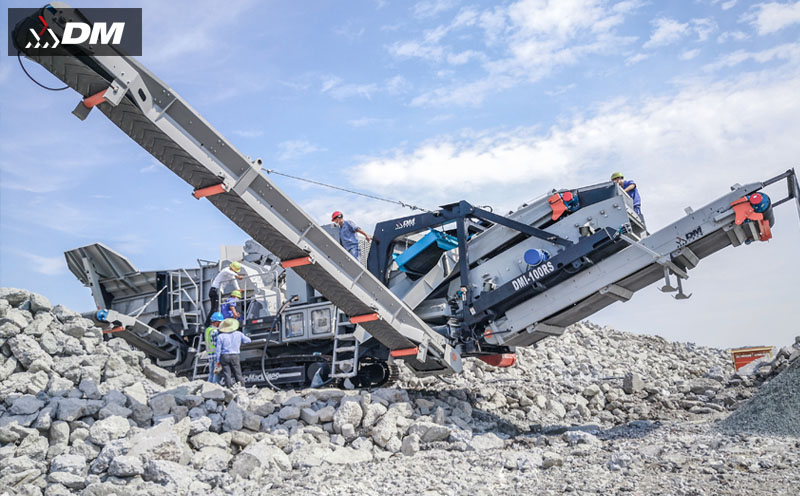
Crawler-type mobile crushing equipment is an efficient mobile crushing solution integrating crushing, screening, and conveying functions. With the unique advantages of crawler chassis, it performs excellently in complex working conditions such as mining, building demolition, and road construction. Compared with tire-type mobile crushing stations, it has irreplaceable advantages in terrain adaptability, operational stability, and heavy-duty crushing fields, and has become the preferred equipment for large open-pit mines and complex site crushing operations.
I. Core Performance Characteristics
Superior Terrain Adaptability
The crawler chassis adopts a wide-track design (usually 500-800mm in width), with a ground pressure as low as 0.08-0.15MPa. It can travel stably on complex terrains such as muddy, mountainous, and sloped areas, with a maximum climbing capacity of 30°, far exceeding that of tire-type equipment (usually ≤15°).
Heavy-Duty Crushing Capacity
It can be equipped with large jaw crushers (processing capacity 100-1000t/h), cone crushers, and other heavy-duty crushing hosts, capable of directly crushing hard rocks with compressive strength ≤350MPa (such as granite and basalt), meeting the large-scale crushing needs of large mines.
Excellent Operational Stability
The equipment has a large self-weight (usually 20-100 tons) and is equipped with retractable outriggers, resulting in low vibration and high stability during crushing operations, especially suitable for fine crushing operations with strict requirements on the shape of finished products.
Flexible Modular Combination
It can be combined into various processes such as "coarse crushing + screening" and "coarse crushing + medium crushing + screening" according to process requirements. Some high-end models support quick replacement of crushing modules (e.g., completing the replacement of jaw crusher and cone crusher within 1 hour).
Comparison of Key Technical Parameters
| Performance Index | Crawler-type Mobile Crushing Equipment | Tire-type Mobile Crushing Equipment |
|---|---|---|
| Maximum Travel Speed | 1-3km/h | 20-30km/h |
| Maximum Climbing Capacity | 25-30° | 10-15° |
| Adaptable Ground Conditions | Muddy, soft, undulating terrain | Hardened roads or flat sites |
| Single Machine Processing Capacity | 100-1000t/h | 50-500t/h |
| Transit Transportation Method | Requires flatbed trailer transportation | Can transfer independently |
II. Typical Application Scenarios
- Large open-pit mines: Especially suitable for stope crushing of metal ores and non-metal ores, can advance with the mining face to reduce ore transportation distance;
- Complex terrain crushing: Such as tunnel slag treatment in mountain road construction, river dredging material processing in water conservancy projects;
- Large-scale construction waste treatment: Can achieve efficient on-site crushing for sites with large demolition areas and complex materials;
- Emergency rescue projects: Ruins cleaning and material recycling after earthquakes and floods.
Reference Application Case
A large iron mine project adopted 3 crawler-type mobile crushing stations to form a combined crushing system:
- 1 jaw crushing crawler station (processing capacity 600t/h) is responsible for coarse crushing, crushing ≤800mm iron ore to 100-150mm;
- 2 cone crushing crawler stations (single machine processing capacity 400t/h) perform medium crushing, with the final product particle size controlled at 10-30mm;
- Compared with the traditional fixed crushing line, the construction period is shortened by 60%, and the annual transportation cost is saved by about 8 million yuan.
III. Operation and Usage Specifications
1. Site Preparation and Equipment Positioning
Clear obstacles and soft foundations in the working site, and lay steel plates for reinforcement if necessary; after the equipment is delivered by flatbed trailer, use the built-in hydraulic outriggers to level the machine body, ensuring the horizontal deviation is ≤0.5°.
2. Pre-start Inspection
Focus on checking: whether the crawler tension is appropriate, whether the oil quantity at each lubrication point is sufficient, whether there are foreign objects in the crushing chamber, whether the electrical system is well grounded, and whether the safety protection devices are complete.
3. No-load Test Run
Start the equipment in the order of "screening system → conveying system → crushing host" under no-load condition, run for 5-10 minutes, and confirm that all components are running normally without abnormal noise before carrying out loaded operation.
4. Normal Operation
Maintain uniform feeding to avoid overloading; adjust the crushing gap according to material properties (jaw crusher through adjusting gaskets, cone crusher through hydraulic system); closely monitor equipment vibration, oil temperature (should not exceed 80℃) and current changes.
5. Shutdown Operation
Stop feeding first, and after the materials in the crushing chamber are emptied, stop the equipment in the order of "crushing host → conveying system → screening system"; clean the residual materials in the crushing chamber and screen surface, and turn off the main power supply.
IV. Daily Maintenance and Care Points
1. Crawler System Maintenance
- Check the tightness of crawler plate bolts daily, and clean stones and soil between crawler tracks weekly;
- Check the crawler tension monthly (standard sag is 20-30mm), and replenish crawler lubricating oil in time;
- Avoid high-speed driving on sharp stones to reduce crawler plate wear.
2. Crushing System Maintenance
- Jaw crusher: Check the wear condition of jaw plates every 8 working hours, adjust the jaw plate gap; lubricate the eccentric shaft bearing every 50 hours;
- Cone crusher: Check the hydraulic oil level and temperature every 12 working hours, replace the hydraulic oil filter every 100 hours;
- Regularly check the wear condition of vulnerable parts such as liners, hammers, and impact plates, and replace them in time.
3. Hydraulic and Electrical System Maintenance
- Keep the hydraulic oil clean, replace the hydraulic oil every 500 hours, and the oil level should be maintained at 2/3 of the liquid level gauge;
- Dust the electrical system once a month, check the tightness of wiring terminals, and ensure the sensors work normally;
- After working in rainy days, timely check the tightness of the electrical cabinet to prevent moisture and short circuit.
V. Common Problems and Solutions
| Common Problems | Possible Causes | Solutions |
|---|---|---|
| Crawler walking deviation | Inconsistent tension of both crawlers; uneven wear of crawler plates | Adjust crawler tension; replace severely worn crawler plates |
| Coarser crushed product particle size | Excessive crushing gap; severe wear of liners | Adjust crushing gap; replace with new liners |
| Abnormal increase in equipment vibration | Uneven feeding; iron blocks in the crushing chamber; uneven foundation | Adjust feeding amount; remove iron blocks; re-level the equipment |
| High oil temperature in hydraulic system | Insufficient oil level; blocked radiator; hydraulic pump failure | Replenish hydraulic oil; clean the radiator; repair or replace the hydraulic pump |
VI. Purchase and Usage Suggestions
- Select according to needs: For hard rock crushing, priority is given to crawler stations with jaw crusher + cone crusher combination; for construction waste treatment, jaw crusher + impact crusher combination can be selected;
- Pay attention to core configurations: Priority is given to equipment equipped with internationally renowned brand hydraulic systems (such as Rexroth, Parker) and engines (such as Cummins, Volvo);
- Attach importance to operation training: Crawler-type equipment is more complex to operate than tire-type equipment, so operators need to receive systematic training and can only work after passing the assessment;
- Formulate maintenance plans: Develop daily, weekly, and monthly maintenance plans according to the workload, record equipment operation data, and predict faults in advance.
Crawler-type mobile crushing equipment has demonstrated significant advantages in complex working conditions with its strong terrain adaptability and crushing performance. Scientific and reasonable use and maintenance can not only extend the service life of the equipment (usually 8-10 years) but also ensure long-term stable high production efficiency, providing reliable equipment support for various large-scale crushing projects.












We will answer your email shortly!