

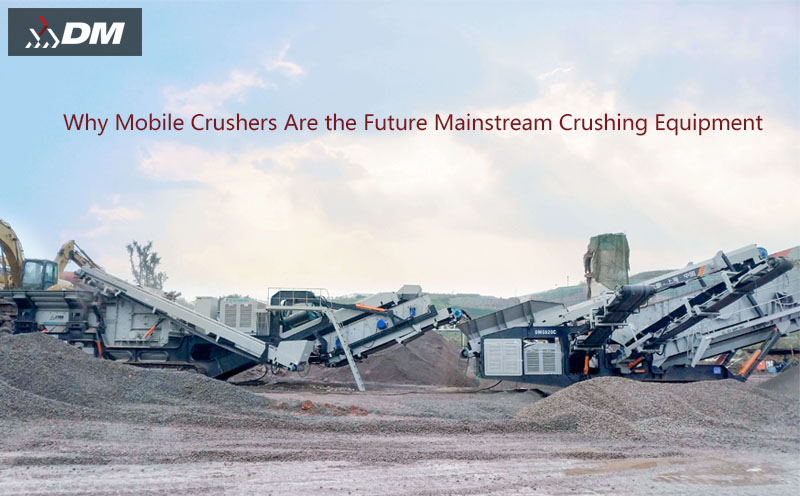
Mobile crushers are considered the future mainstream of crushing equipment, primarily because they can accurately meet the core requirements of modern industrial development for flexibility, efficiency, environmental protection, and scenario adaptability. The specific reasons can be elaborated as follows:
I. Solving Core Pain Points of Traditional Crushing Modes and Significantly Improving Efficiency
Traditional fixed crushing stations have two prominent problems: first, they are subject to strict site restrictions, requiring fixed factories, complex infrastructure, and long-term planning, making them extremely unsuitable for temporary projects or scenarios with changing sites (such as mine stripping and road emergency repairs); second, material transportation costs are high, especially for "dispersed raw materials" such as construction waste and mine overburden, where transportation costs from the mining/generation site to the fixed crushing station may account for 30%-50% of the total cost.
Mobile crushers, however, can operate directly at the raw material site, achieving "on-site crushing and nearby utilization": for example, construction waste from demolition sites can be directly crushed into recycled aggregates for use in surrounding road bases; mines can move equipment as the mining face advances, reducing repeated infrastructure investment. This "zero-transport" model can increase overall operational efficiency by more than 40% and significantly reduce comprehensive costs.
II. Adapting to Diversified Scenario Needs with Unmatched Flexibility
Contemporary crushing needs are shifting from "single fixed large-scale production" to "multi-scenario, small-batch, customized" production. The modular design and rapid adjustment capabilities of mobile crushers perfectly align with this trend:
- In the mining field, they can be equipped with different main machines such as jaw crushers, cone crushers, and impact crushers, adapting to diverse crushing needs from hard rocks (granite) to soft rocks (limestone), and can move with the mining face, reducing repeated infrastructure investment;
- In municipal engineering, they can be quickly deployed at construction waste treatment sites and road repair sites, even operating with low noise in urban core areas;
- In emergency scenarios (such as debris clearance after earthquakes and river dredging after floods), they can quickly respond and engage in crushing operations, which traditional fixed equipment cannot match.
III. Aligning with Environmental Protection and Sustainable Development Trends
Global requirements for "green production" are becoming increasingly stringent, and mobile crushers have significant advantages in environmental performance:
- Modern mobile equipment is generally equipped with closed crushing chambers, efficient dust removal systems, and low-noise engines, with dust emission concentrations controlled below 10mg/m³ and noise reduced to within 75 decibels, meeting environmental standards in urban and ecologically sensitive areas;
- For "dispersed waste" such as construction waste and industrial solid waste, mobile crushers can achieve "on-site resource utilization", reducing secondary pollution caused by long-distance transportation of waste and contributing to the construction of "zero-waste cities";
- Some new energy mobile crushers (such as electric crawler-type) can achieve zero emissions, fully complying with industrial upgrading needs under the "dual carbon" goals.
IV. Technological Upgrades Driving Performance Leap and Reducing Operational Threshold
With advancements in mechanical manufacturing and intelligent control technology, mobile crushers have shed their early image of being "bulky and inefficient":
- Improved intelligence: Equipped with IoT systems, they can remotely monitor equipment operation status, warn of faults, and automatically adjust crushing parameters (such as adjusting rotation speed according to material hardness), reducing reliance on professional operators;
- Power and endurance optimization: Diesel-powered models have reduced fuel consumption by more than 20%, while electric models have improved endurance, meeting all-day continuous operation needs;
- Structural lightweighting: Using high-strength alloy materials, the weight is reduced while ensuring stability. The crawler chassis has stronger climbing ability and terrain adaptability, even capable of operating on slopes exceeding 25°.
V. Driven by Both Policy and Market Demand
At the policy level, supportive policies for construction waste recycling, mine ecological restoration, and small-scale decentralized processing in various countries (such as China's "14th Five-Year Plan for Circular Economy Development") have created broad application space for mobile crushers; at the market level, crushing demand in fields such as small and medium-sized mines, municipal engineering, and rural construction is growing rapidly, and these scenarios prefer mobile equipment with "low investment, quick commissioning, and easy relocation".
In summary, by addressing efficiency bottlenecks of traditional models, adapting to diversified scenarios, meeting environmental protection requirements, and continuously optimizing performance through technological upgrades, mobile crushers are gradually replacing fixed equipment to become mainstream. Especially in the future "decentralized, green, and intelligent" crushing market, their core position will become even more prominent.












We will answer your email shortly!