

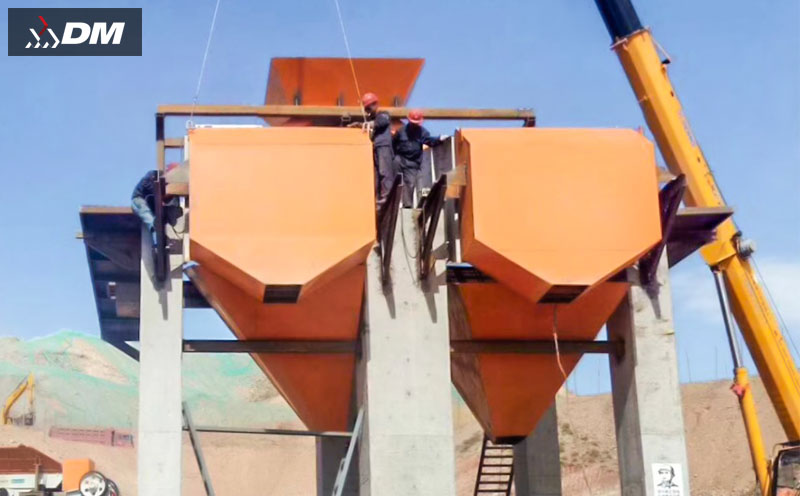
As a core crushing equipment in highway and railway construction, impact crushers play an irreplaceable role in key links such as aggregate production, subgrade treatment, and pavement/track structure construction, thanks to their characteristics of high crushing efficiency, excellent finished product grain shape, and strong adaptability. They directly affect project quality, cost control, and construction progress. The following details their core roles and advantages based on specific scenarios of highway and railway construction:
I. Core Common Role: Providing "Qualified Aggregates" for Projects
Highway and railway construction consume massive amounts of sand and gravel aggregates (used in concrete, asphalt mixtures, subgrade fillers, etc.). However, natural sand and gravel resources are increasingly scarce and of unstable quality. The core function of impact crushers is to crush raw materials such as mine raw stones (e.g., granite, limestone, basalt), construction waste, and tunnel muck into "customized aggregates" that meet engineering standards, solving the problem of aggregate supply.
The key value of impact crushers in aggregate production is reflected in the following aspects:
- Controlling aggregate grain shape to ensure project strength
Impact crushers adopt the principle of "impact crushing + stone-on-stone". The crushed aggregates are cubical (needle-flake content ≤ 10%) and have strong interlocking properties — this is crucial for the compressive strength of concrete structures (e.g., railway sleepers, highway bridge piers) and the rutting resistance of asphalt pavements. If aggregates with poor grain shapes (e.g., coarse crushed materials from jaw crushers with high needle-flake content) are used, it will lead to insufficient concrete compactness and easy pavement cracking, directly reducing the service life of the project. - Flexibly adjusting particle size to adapt to multi-scenario needs
By adjusting the "impact plate gap" of the crusher, the particle size of the finished aggregate can be precisely controlled (usually covering the range of 5-31.5mm) to meet the needs of different construction scenarios:- Coarse aggregates (16-31.5mm): Used for concrete frameworks and subgrade base filling;
- Medium aggregates (5-16mm): Used for asphalt mixtures and supplementary fine aggregates in concrete;
- Fine aggregates (0-5mm, requiring matching with sand making machines): Used for concrete mortar and pavement leveling layers.
- Processing multiple raw materials to reduce aggregate costs
Compared with relying on natural sand and gravel, impact crushers can directly use tunnel muck and subgrade excavation stones generated on the project site (e.g., basalt muck from railway tunnel construction, limestone from highway cutting excavation) to realize "local material utilization and turning waste into treasure". This not only reduces raw material transportation costs (transportation costs per kilometer can be reduced by 30%-50%) but also avoids the environmental pressure of natural sand and gravel mining, conforming to the requirements of "green infrastructure".
II. Specialized Roles in Highway Construction
Highway construction has high requirements for "pavement flatness, impermeability, and durability". Impact crushers play a role throughout the three major structural layers of subgrade, base course, and surface course:
| Construction Link | Specific Roles | Engineering Significance |
|---|---|---|
| Subgrade Construction | 1. Crushing subgrade fillers: Crushing excavated earth-rock mixed raw materials into uniform particles (particle size ≤ 50mm) to prevent subgrade settlement caused by uneven particles; 2. Treating soft soil subgrades: Using crushed high-strength aggregates (e.g., granite crushed materials) as subgrade replacement materials to improve foundation bearing capacity. |
Ensuring subgrade stability and avoiding problems such as "bridge-head bumping" and "subgrade collapse" after the highway is open to traffic. |
| Base Course/Subbase Course Construction | Crushing and producing "water-stabilized macadam aggregates" (particle size 5-31.5mm) for cement-stabilized macadam base courses. The aggregates produced by impact crushers have continuous gradation, which can reduce cement consumption (lowering costs) while improving the crack resistance and bearing capacity of the base course. | Providing "rigid support" for the pavement and extending the service life of asphalt/cement pavements (usually by 2-3 years). |
| Surface Course Construction | 1. Crushing high-quality basalt/andesite to produce "upper surface course aggregates" (particle size 3-13.2mm) for asphalt pavements — cubical aggregates have stronger adhesion to asphalt, which can improve pavement skid resistance and rutting resistance; 2. Crushing limestone to produce aggregates for cement concrete pavements (mud content needs to be controlled ≤ 1%) to ensure pavement strength. |
Directly determining the driving safety and comfort of the highway and reducing early pavement damage (e.g., cracks, potholes). |
III. Specialized Roles in Railway Construction
Railways (especially high-speed railways and heavy-haul railways) have much higher requirements for "track smoothness and structural durability" than highways. The roles of impact crushers focus on track foundations, concrete structures, and ballast production:
- Ballastless Track (mainstream for high-speed railways) Construction: Producing High-Grade Concrete Aggregates
The track slabs and base slabs of high-speed railway ballastless tracks require concrete of C50 grade or above, which has strict requirements for the "strength, gradation, and impurity content" of aggregates. Impact crushers can produce aggregates through a combined process of "coarse crushing (jaw crusher) + medium crushing (impact crusher) + sand making + screening":- Crushed stone aggregates: Crushing value ≤ 10% (much lower than 16% for highways), needle-flake content ≤ 5%;
- Manufactured sand: Fineness modulus 2.6-3.0, stone powder content 3%-5% (improving concrete workability);
- Ballasted Track Construction: Producing High-Quality Ballast
Tracks of ordinary-speed railways and heavy-haul railways need to be paved with "crushed stone ballast" (particle size 20-70mm) for dispersing train loads, draining water, and adjusting track elevation. The ballast produced by impact crushers has the following characteristics:- Sharp edges and corners: High friction between particles, preventing ballast "pulverization" and track displacement;
- Uniform gradation: Avoiding poor drainage caused by excessive ballast gaps (the void ratio of railway ballast needs to be controlled at 35%-40%);
- Railway Bridge/Tunnel Construction: Customized Aggregate Production
- Bridges: Crushing high-strength granite/diabase to produce concrete aggregates for bridge piers and beam bodies (needing to meet frost resistance and impermeability requirements, especially in cold regions in northern China);
- Tunnels: Using tunnel muck for crushing to produce "secondary lining concrete aggregates" and "invert filling aggregates", realizing "zero waste discharge" in tunnel construction and reducing raw material transportation costs (tunnels are mostly located in mountainous areas, where transportation costs account for a high proportion).
IV. Unique Advantages of Impact Crushers: Why They Are the First Choice for Infrastructure?
Compared with jaw crushers (only for coarse crushing) and cone crushers (focusing on fine crushing of hard rocks), impact crushers have advantages more in line with engineering needs in highway and railway construction:
- Better grain shape: The impact crushing principle determines that the finished product is cubical, solving the problems of "high needle-flake content" of jaw crushers and "high cost" of cone crushers;
- Higher efficiency: The processing capacity can reach 100-800t/h (adapting to the continuous construction needs of large-scale infrastructure projects), and the crushing ratio (raw material particle size/finished product particle size) can reach 15-30 (only 5-8 for jaw crushers), reducing crushing links;
- Strong adaptability: Can crush various rocks with compressive strength ≤ 350MPa (e.g., limestone, granite, basalt) and can process raw materials with mud content ≤ 5% without additional pretreatment;
- Green and environmentally friendly: Equipped with sealed crushing workshops and dust removal equipment, the dust emission concentration can be controlled below 10mg/m³ (meeting national infrastructure environmental protection standards), reducing construction dust pollution.
V. Conclusion
Impact crushers are the "core equipment for aggregate processing" in highway and railway construction. They not only solve the large-scale demand for high-quality aggregates in projects but also directly ensure the stability of subgrades/tracks and the durability of pavements/structures through characteristics such as "local material utilization, optimized grain shape, and cost control". At the same time, they contribute to the realization of the "green infrastructure" goal. Against the background of the continuous expansion of China's highway and railway network (especially high-speed railways and expressways), the technological upgrading of impact crushers (e.g., intelligent control, large-scale design) will further enhance their role value in infrastructure construction.












We will answer your email shortly!