

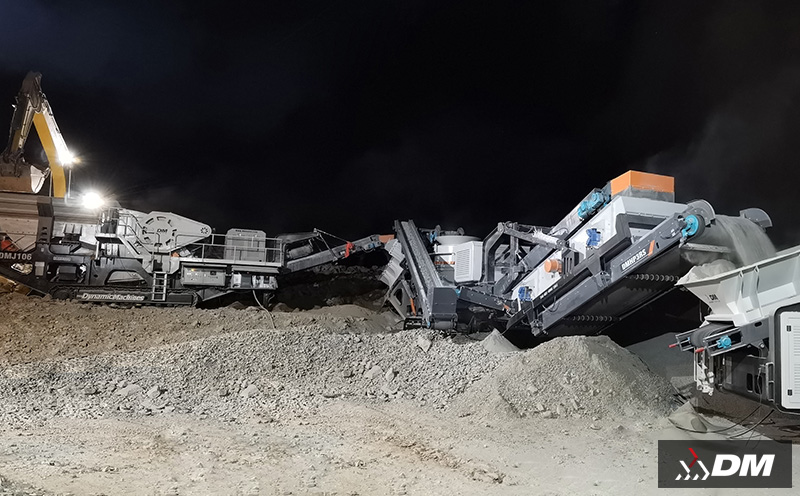
Remote quarry and mining projects often face a difficult starting point. The deposit may be promising, but infrastructure is limited. Roads may be rough, grid power may be unavailable, and civil construction costs can be high before the project has generated any revenue. In these conditions, building a complete fixed crushing plant at the beginning may create financial pressure and schedule risk. A tracked mobile jaw crusher offers a practical alternative by allowing operators to start primary crushing quickly, test material behavior, and generate early production without committing immediately to a full permanent installation.
For overseas customers working in developing regions, mountain quarries, temporary mining contracts, dam projects, and infrastructure corridors, mobility can be a decisive advantage. A tracked mobile jaw crusher combines heavy-duty primary crushing with the ability to move within the site as the working face changes. It helps reduce setup time, lower initial civil work, and provide operational flexibility during the uncertain early stage of a project.
The Challenge of Remote Production
Remote sites usually have several constraints at once. Equipment delivery is difficult. Skilled labor may be limited. Fuel and spare parts logistics require planning. Weather can affect access roads. If a fixed plant is installed before the deposit and market are fully proven, the owner carries significant risk. A tracked mobile jaw crusher helps manage that risk because it can begin work with less foundation construction and can be relocated if the quarry plan changes.
This does not mean mobile equipment replaces fixed plants in every case. For very long-term, high-volume operations, fixed crushing and screening systems may still provide the lowest cost per ton. However, during project start-up, exploration production, contract crushing, or staged investment, the mobile jaw crusher gives the owner more options.
Fast Setup and Earlier Revenue
One of the biggest advantages of a tracked mobile jaw crusher is speed. Once delivered to site, the machine can be positioned, unfolded, checked, and put into operation much faster than a fixed primary station requiring foundations, structural steel, electrical rooms, and extensive conveyors. This allows the project to begin producing usable material earlier.
Early production has strategic value. It can supply road construction inside the project, generate aggregate sales, support investor confidence, or provide bulk samples for customer approval. Instead of waiting months for a full plant, the operator can start learning from real material immediately. Feed size, wear rate, clay content, capacity, and product demand can all be tested under practical conditions.
Following the Quarry Face
In a developing quarry, the working face changes as benches are opened and haul roads are built. If the primary crusher is fixed far from the face, trucks must travel longer distances as extraction advances. This increases fuel cost, tire wear, cycle time, and fleet requirements. A tracked mobile jaw crusher can move closer to the active face, reducing internal haulage and improving loading efficiency.
This is especially useful when processing blasted rock in rugged terrain. The excavator or wheel loader can feed the crusher near the source, and crushed material can be conveyed or hauled more efficiently. Even small reductions in truck cycle time can produce large savings over thousands of tons.
Handling Hard and Variable Feed
Remote quarry deposits are not always consistent. Material may vary from weathered rock to hard fresh stone, with occasional oversize blocks. A tracked mobile jaw crusher is designed for primary reduction and can handle difficult feed when properly selected. Key features include a large feed opening, robust jaw plates, strong frame, hydraulic setting adjustment, and overload protection.
For granite, basalt, limestone, iron ore, river stone, and other materials, the mobile jaw crusher creates a manageable product size for secondary crushing or direct use as base material. If higher-quality aggregate is required, it can be combined with a tracked mobile cone crusher, impact crusher, or screening machine. The jaw unit becomes the first step in a modular production system that can grow with the project.
Reducing Civil Work and Permitting Pressure
Fixed plants often require significant civil engineering. Foundations, retaining walls, loading ramps, control rooms, power distribution, and drainage systems all add cost and time. In remote areas, importing concrete, steel, and skilled crews can be expensive. A tracked mobile jaw crusher reduces this burden because it is self-contained and mounted on tracks.
This can also help with permitting or temporary project approvals. Some projects need production before a permanent plant permit is finalized. Mobile crushing may provide a bridge solution, allowing the operator to supply construction material while long-term approvals are completed. Local regulations vary, but flexibility is valuable when project timelines are uncertain.
Supporting Contract Crushing
Many overseas markets rely on contractors to provide crushing services for quarry owners, road projects, and mining companies. A tracked mobile jaw crusher is a strong asset for contract crushing because it can be transported between jobs and set up quickly. The contractor can serve multiple customers instead of waiting for one fixed plant to pay back investment.
Contractors also benefit from the machine’s ability to handle different feed materials. One project may involve limestone for road base, another may require crushing hard rock for concrete aggregate, and another may involve demolition concrete. With the right configuration and support equipment, the mobile jaw crusher can remain productive across varied applications.
Maintenance in Remote Conditions
Remote work makes maintenance discipline even more important. A breakdown that might be simple in a city can become costly when parts and technicians are far away. A tracked mobile jaw crusher should be chosen with service access, parts availability, and operator training in mind. Daily checks should include jaw plates, cheek plates, belts, tracks, hydraulic systems, engine components, lubrication points, and safety devices.
Operators should also monitor feed behavior. Oversize material, steel contamination, or uneven loading can reduce performance and damage components. A steady feed from a suitable excavator or loader improves capacity and reduces shock loading. Keeping critical wear parts on site is highly recommended for remote projects.
Pathway to a Full Crushing Plant
A mobile jaw crusher can be the first step in a staged investment plan. Once the project proves material quality, market demand, and production volume, the owner may add mobile screening, secondary cone crushing, or eventually a fixed plant. The tracked mobile jaw crusher can continue working as a primary unit, a backup crusher, or a satellite unit in another part of the quarry.
This staged approach reduces financial exposure. Instead of investing heavily before the business case is proven, the owner builds capacity in line with demand. For many emerging-market projects, this is a more practical route to long-term success.
Investment Evaluation
The return on investment for a tracked mobile jaw crusher should include more than crushing capacity. Customers should calculate saved civil work, faster production start, reduced haulage, lower relocation cost, contract flexibility, and resale value. In remote projects, the value of time can be especially high. Starting production several months earlier may improve cash flow enough to justify the mobile solution.
Service support is also part of investment value. A low-cost machine without parts support can become expensive if downtime occurs. Overseas customers should evaluate supplier experience, spare parts stock, technical training, and remote support capability before purchasing.
Conclusion
A tracked mobile jaw crusher helps remote quarry and mining projects move from planning to production faster. It reduces civil work, follows the working face, handles demanding primary crushing, and supports staged investment. For contractors and project owners facing uncertain geology, changing site conditions, or limited infrastructure, it provides a flexible path to early revenue and practical material control. When selected and operated correctly, a mobile jaw crusher is not just a temporary machine. It is a strategic tool for launching production with lower risk and stronger control over the project timeline.












We will answer your email shortly!