

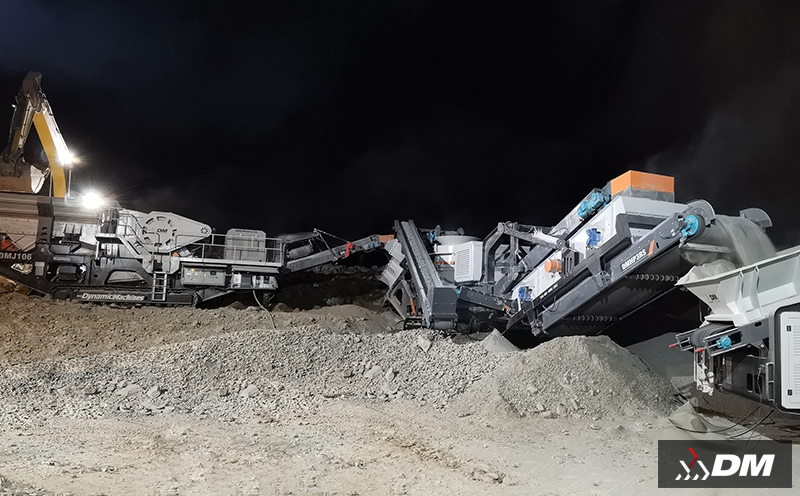
A mobile crusher is an integrated crushing equipment that integrates feeding, crushing, screening and conveying on a wheeled or crawler chassis. It can move independently or be towed between sites, and can be put into operation immediately upon arrival without any civil foundation. It is widely used in global mines, quarries, infrastructure projects and construction waste treatment.
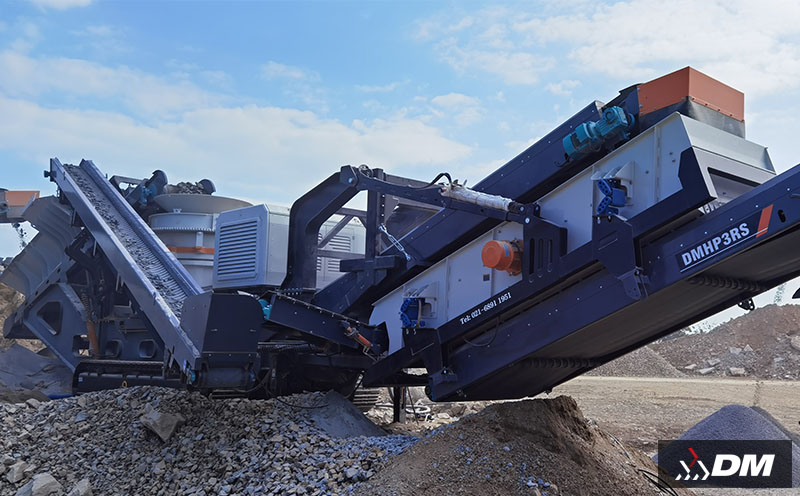
A stationary crusher, by contrast, is fixed on a concrete foundation with matched workshops and conveying systems. It is mostly used in large-scale sand and gravel and mining projects for long-term, stable and large-volume production.
Core Definitions and Features
Mobile Crusher
Adopts integrated design, with two chassis types: wheeled (suitable for road transfer) and crawler (suitable for all terrains in mountainous and mining areas). Supports diesel-electric dual power, enables on-site crushing and greatly reduces material transportation costs. Ideal for temporary projects, scattered mining areas and sites with limited space.
Stationary Crusher
Consists of combined production lines including jaw crusher, cone crusher, impact crusher, vibrating screen and more. Requires foundation construction, pipeline laying and workshop building. Features large single-machine capacity and stable performance, suitable for long-term continuous and large-scale standardized production.
Key Differences Between Mobile Crusher and Stationary Crusher
1. Mobility and Deployment
- Mobile crusher: No infrastructure needed, ready for production on arrival, easy to relocate, suitable for multi-site operations.
- Stationary crusher: Requires foundation pouring and installation, long construction period, high relocation cost, fixed-point production only.
2. Capacity and Scale
- Mobile crusher: Medium capacity per unit, flexible for medium-small output and temporary demands.
- Stationary crusher: Multi-stage combined, higher output capacity, suitable for large mines and large-scale aggregate bases.
3. Cost and Investment
- Mobile crusher: Saves infrastructure and logistics costs, flexible upfront investment, quick payback.
- Stationary crusher: High investment in equipment, civil works and supporting facilities, suitable for long-term stable operation.
4. Application Scenarios
- Mobile crusher: Scattered mining areas, temporary quarrying, construction waste recycling, remote sites, road emergency repair.
- Stationary crusher: Large quarries, long-term mines, large-scale infrastructure aggregate bases, industrial park production lines.
5. Operation and Maintenance
- Mobile crusher: Integrated control, simple operation and convenient maintenance.
- Stationary crusher: Complex system, requires professional operation and maintenance, suitable for standardized plant management.
Global Selection Guide
- Short-term projects, multi-site operations, mountainous mining areas: Prioritize mobile crusher for flexibility, efficiency and obvious cost reduction.
- Long-term large mines and large-scale sand and gravel plants: Prioritize stationary crusher for stable capacity and lower overall cost.
- Strict environmental protection areas and urban projects: Mobile crusher is easier to equip with noise reduction and dust removal devices, meeting global environmental requirements.
Conclusion
The mobile crusher has core advantages of flexibility, speed and no infrastructure construction, meeting global mobile crushing demands. The stationary crusher excels in high output, stability and large-scale production, suitable for long-term large projects. There is no absolute superiority between them. The best benefit can be achieved by choosing according to project cycle, site conditions, capacity requirements and operation mode.
Which is better: mobile crusher or stationary crusher? — Shanghai Dongmeng, Your Preferred Global Crushing Solution
In the fields of global mining, infrastructure, solid waste recycling and sand & aggregate production, mobile crushers and stationary crushers are both core industry equipment, but they suit completely different working conditions and demands. To judge which is better mainly depends on project scale, material properties, operation scenarios, cost budget and global adaptability. As a benchmark manufacturer of global crushing and screening equipment, Shanghai Dongmeng, with service experience in more than 80 countries, explains the core differences between the two for global customers to help with quick selection.
1. Core Difference Comparison: Mobile vs Stationary Crusher
| Comparison Item | Mobile Crusher (Crawler / Wheeled) | Stationary Crusher (Production Line) |
| Application Scenarios | Remote mines, mobile operations, solid waste recycling, temporary infrastructure (roads / hydropower), scattered multi-material sites | Large sand & gravel plants, long-term mining, fixed production bases, large-scale solid waste treatment parks |
| Relocation Capability | Self-propelled or traction relocation, no infrastructure needed, can switch 2-3 work sites per day | Fixed installation, requires foundation pouring, relocation needs disassembly and reassembly, cycle 15-30 days |
| Initial Investment | Relatively high single-machine cost, no infrastructure cost, low overall investment (suitable for small and medium projects) | High total investment in equipment + infrastructure, suitable for long-term stable projects |
| Operating Cost | On-site crushing reduces transportation cost by over 60%, but slightly higher single-machine energy consumption | Lower energy consumption in large-scale operation, requires long-distance material transportation with high transportation cost ratio |
| Production Capacity | Single unit capacity 80-360 tons per hour, suitable for small and medium batches, multi-scenario operations | Complete line capacity 500-2000 tons per hour, suitable for large-scale continuous production |
| Global Adaptability | Modular design for easy sea transportation, adapts to tropical, frigid, dusty and complex working conditions | Needs customized adaptation to regional environmental standards, long installation and commissioning period |
2. Three Core Scenarios Where Mobile Crushers Are Better
1. Remote / Mobile Operation Scenarios
In remote global mining areas, African grasslands, South American plateaus and other regions with scattered materials and no fixed sites, crawler mobile crushers require no infrastructure and can start production immediately on site, greatly reducing cross-regional material transportation costs. They also adapt to slopes and muddy terrains, easily handling complex road conditions, making them the first choice for global remote projects.
2. Solid Waste Recycling and Temporary Infrastructure
For short-cycle, high-fluidity materials such as urban construction waste, demolition sites and road engineering waste, wheeled mobile crushers can relocate quickly and crush materials on site into recycled aggregates to realize resource recycling and avoid secondary pollution. They meet temporary aggregate demands in rapidly developing infrastructure regions such as the Middle East and Southeast Asia, producing as needed.
3. Small and Medium-scale Projects / Overseas Pilot Projects
For global small and medium-sized miners and overseas new market expansion projects, mobile crushers feature low investment and quick returns. They require no long-term site investment and can quickly verify production capacity and market demand, reducing investment risks.
3. Three Core Scenarios Where Stationary Crushers Are Better
1. Long-term Stable Large-scale Production
For long-term stable operation scenarios such as large sand & aggregate plants, metal mining bases and solid waste treatment parks, stationary crusher complete lines feature high capacity (over 500 tons per hour). Large-scale operation can reduce unit energy consumption by 15%-20%, and 24-hour continuous production is realized through automatic control systems, suitable for stable aggregate supply for global large-scale infrastructure projects.
2. High-hardness / High-value Material Processing
For high-hardness and high-value materials such as granite, basalt and iron ore, stationary production lines adopt multi-machine linkage to precisely control finished product grain shape, with needle flake content lower than 5%, meeting high-end aggregate standards in Europe, America, the Middle East and other regions, suitable for global high-end building materials and mining projects.
3. Regional Centralized Treatment
For centrally distributed materials in a region, stationary crushers realize centralized treatment, improve resource utilization, and facilitate unified management and environmental supervision, suitable for long-term operation in regions with strict environmental requirements such as Europe and North America.
4. Shanghai Dongmeng: Selection Solutions for Global Customers
As a high-tech enterprise integrating R&D, production and export, Shanghai Dongmeng provides "mobile + stationary" dual-selection solutions for the global market, helping customers choose accurately without struggling over which is better.
Mobile Crushing Series: Cover crawler (all-terrain) and wheeled (road transfer) types, equipped with jaw crusher, cone crusher, impact crusher, sand making machine and other main units, adapting to working conditions in more than 80 countries, supporting customized configurations.
Stationary Crushing Production Line: Provides complete solutions for primary crushing, secondary & fine crushing, sand making and shaping, certified by ISO9001, with imported core parts, high temperature resistance and wear resistance, adapting to complex global working conditions, with global on-site installation, commissioning and lifelong maintenance services.
One-stop Selection Service: Provides customized solutions quickly according to customer’s region, material properties, production capacity demand and budget, with detailed quotations and project cases to reduce decision-making costs for global customers.
5. Summary: No Absolute "Better", Only More "Suitable"
Choose Mobile Crusher: Priority for mobile operations, short cycles, remote scenarios and small to medium capacity needs, a cost-effective choice worldwide.
Choose Stationary Crusher: Priority for long-term stable, large-scale, high-capacity and high-end material processing needs, the cornerstone of global large-scale development.
Shanghai Dongmeng has been deeply engaged in the global crushing equipment field for more than 30 years. With high-quality products and full life cycle services, it has helped customers in more than 80 countries achieve efficient crushing and resource utilization. Whether you are engaged in global mining development, infrastructure projects or solid waste recycling, you can contact the International Marketing Department of Shanghai Dongmeng to get exclusive selection solutions and accurate quotations, supporting the efficient implementation of global projects.












We will answer your email shortly!