

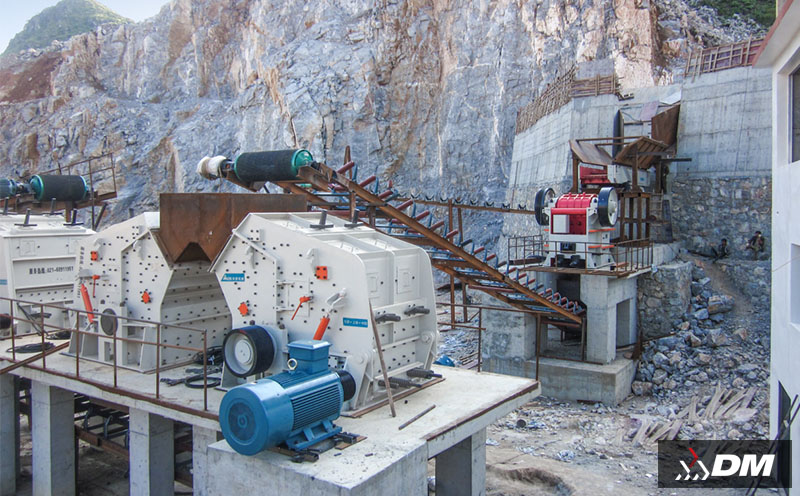
In the fields of sand and aggregate production, mining and construction waste treatment, the impact crusher is a widely used crushing equipment. With its unique working principle and excellent finished product particle shape, it has become an ideal choice for crushing medium-hardness materials. So what exactly is an impact crusher? What are its features and advantages? This article will give you a comprehensive analysis.
Basic Concept
Impact crusher is a kind of equipment that uses the impact principle to crush materials. It drives the blow bars through the high-speed rotating rotor to throw the materials entering the crushing chamber to the impact plate at a high speed. The materials are crushed after a violent impact with the impact plate, and then rebound back to the blow bar area to form repeated cyclic impact crushing until the materials reach the required particle size and are discharged from the discharge port.
Impact crushers are mainly used for secondary and fine crushing operations, suitable for processing various materials with side length not exceeding 500mm and compressive strength not exceeding 250MPa, such as limestone, dolomite, gypsum, coal gangue and other medium-hardness materials.
Structure and Working Principle
Core Structure
Impact crusher is mainly composed of the following parts:
Frame: the main structure carrying all components
Rotor: the core component rotating at high speed with blow bars installed
Blow bar: wear-resistant part that directly impacts materials
Impact plate: crushing surface bearing material impact, adjustable angle
Adjustment device: used to adjust the gap between impact plate and blow bar to control discharge particle size
Working Principle
The working process of impact crusher is divided into three stages:
1. Impact crushing: after entering the crushing chamber from the feed port, materials are impacted by the high-speed rotating blow bar, obtain huge kinetic energy, and are thrown to the impact plate.
2. Impact crushing: materials collide violently with the impact plate and break under the impact force. The crushed materials are rebounded back to the blow bar area by the impact plate and impacted again.
3. Cyclic crushing: materials are impacted and collided repeatedly between the blow bar and the impact plate until the particle size is smaller than the gap between the impact plate and the blow bar, and discharged from the discharge port.
In the whole crushing process, materials are not only impacted by blow bars and impact plates, but also collide with each other for further refinement and shaping.
Main Features of Impact Crusher
1. Large crushing ratio
The crushing ratio of impact crusher can reach 10-20, up to more than 40. This means it can crush large materials to a small particle size at one time, and can realize single-stage crushing in some production lines to simplify the process flow.
2. Excellent product particle shape
Materials produced by impact crusher are cubic, with low needle and flake content (usually less than 10%), making it an ideal equipment for producing high-quality aggregates. This feature makes it widely used in high-grade highways, high-speed railways and other projects with strict particle shape requirements.
3. High crushing efficiency
Crushing by impact principle makes full use of energy with low unit energy consumption. Compared with extrusion crushing equipment, impact crusher has higher crushing efficiency when processing medium-hardness materials.
4. Simple structure and convenient maintenance
Impact crusher has a relatively simple structure, vulnerable parts such as blow bars and impact plates are easy to replace, and daily maintenance workload is small.
5. Adjustable discharge particle size
By adjusting the gap between the impact plate and the blow bar, the discharge particle size can be easily controlled to meet different finished product requirements.
Differences Between Impact Crusher and Cone Crusher
| Comparison Item | Impact Crusher | Cone Crusher |
| Applicable Materials | Medium hardness (≤250MPa) | High hardness (≤320MPa) |
| Working Principle | Impact crushing | Lamination crushing |
| Product Particle Shape | Cubic, less needle flakes | Good shape, slightly inferior to impact crusher |
| Wear Parts Life | Relatively short blow bar life | Longer crushing wall life |
| Energy Consumption | Lower unit energy consumption | Higher unit energy consumption |
| Application Scenarios | High-quality aggregate production | Fine crushing of high-hardness materials |
Application Fields of Impact Crusher
1. Sand and aggregate production
Impact crusher is one of the core equipment of sand and aggregate production lines, especially suitable for producing crushed stones for high-grade highways and high-speed railways. Its products have excellent particle shape and stable gradation, which can meet strict technical requirements.
2. Mining
In medium-hardness metal mines (such as lead-zinc mines, copper mines) and non-metal mines (such as limestone mines), impact crushers are used for secondary and fine crushing operations.
3. Construction waste recycling
In the treatment of construction wastes such as waste concrete and bricks, impact crushers can crush large construction wastes to reusable particle size to produce recycled aggregates.
4. Cement industry
Impact crusher is a common equipment for limestone crushing in cement production lines, crushing large limestone to the particle size required by raw material mills.
Types of Impact Crusher
1. Single-rotor impact crusher
With only one rotor, simple structure and moderate processing capacity, suitable for small and medium-sized production lines.
2. Double-rotor impact crusher
With two rotors, stronger crushing capacity and larger processing capacity, suitable for large-scale production.
3. Hydraulic impact crusher
Adopt hydraulic system to adjust the position of impact plate, more convenient operation and realize automatic control.
Selection Suggestions
When choosing an impact crusher, it is recommended to consider the following factors comprehensively:
1. Material characteristics: confirm the compressive strength, moisture content, mud content of the material to ensure it is within the applicable range of the equipment
2. Finished product requirements: clarify the target particle size, particle shape and gradation requirements
3. Processing capacity: select the appropriate model specification according to project needs
4. Process flow: determine the position of impact crusher in the whole production line (secondary crushing or fine crushing)
5. Investment and operation cost: comprehensively consider equipment procurement cost and wear parts replacement frequency
Conclusion
Impact crusher is a high-efficiency equipment for crushing by impact principle. With the advantages of large crushing ratio, excellent product particle shape and simple structure, it is widely used in global sand and aggregate production, mining, construction waste treatment and other fields.
For the production of medium-hardness materials, impact crusher is an ideal choice for high-quality aggregates. The cubic crushed stones it produces are high-quality materials for high-grade projects such as highways and high-speed railways. With the continuous advancement of global infrastructure construction, impact crusher will continue to play an irreplaceable role in aggregate production.
What is the difference between jaw crusher and impact crusher?
In the fields of sand and aggregate production, mining and construction waste treatment, jaw crusher and vertical shaft impact crusher are two common but functionally different equipments. Many users are often confused when choosing: what is the difference between them? How to choose? This article will systematically analyze the core differences between the two equipments to help you make a wise selection decision.
Basic Concept
Jaw Crusher
Jaw crusher is a primary crushing equipment based on extrusion crushing. It applies huge extrusion and shear forces to materials through the periodic approaching and moving away of fixed jaw plate and movable jaw plate, crushing large materials into small particles. Jaw crusher is usually located in the first process of the production line, undertaking the task of primary crushing.
Vertical Shaft Impact Crusher
Vertical shaft impact crusher (also known as sand making machine) is a fine crushing and shaping equipment based on impact crushing and stone-on-stone principle. It accelerates and projects materials through high-speed rotating impellers, making high-speed impact between materials or between materials and liners to realize crushing and shaping. Impact crusher is mainly used for sand making and aggregate shaping, located in the last process of the production line.
Core Difference Comparison
| Comparison Dimension | Jaw Crusher | Vertical Shaft Impact Crusher |
| Working Principle | Extrusion crushing + Shear crushing | Impact crushing + Stone-on-stone |
| Applicable Stage | Primary crushing (First process) | Fine crushing, sand making, shaping (Last process) |
| Applicable Materials | High-hardness materials (≤320MPa) | Medium-hardness materials (≤250MPa) |
| Feed Particle Size | Up to more than 1000mm | Usually ≤60mm |
| Discharge Particle Size | 100-300mm (After primary crushing) | 0-10mm (Manufactured sand) |
| Product Particle Shape | High needle and flake content | Cubic shape, excellent particle shape |
| Processing Capacity | 1-1500 tons/hour | 20-500 tons/hour |
| Main Purpose | Crush large raw ores to moderate particle size | Produce manufactured sand, improve aggregate particle shape |
Working Principle Differences
Jaw Crusher: Extrusion Crushing
The working principle of jaw crusher is to extrude and bend materials through two jaw plates. When the movable jaw plate approaches the fixed jaw plate, the materials in the crushing chamber are crushed by huge extrusion and shear forces; when the movable jaw plate retreats, the crushed materials are discharged from the discharge port under the action of gravity. This periodic movement of crushing when approaching and discharging when moving away is carried out continuously at a frequency of 200-400 times per minute, realizing intermittent crushing and discharging of materials.
Vertical Shaft Impact Crusher: Stone-on-Stone and Stone-on-Iron
The working principle of vertical shaft impact crusher is more complex, mainly including two modes:
Stone-on-stone: materials are fed from the top, evenly distributed by the distributor, accelerated and projected by the high-speed rotating impeller, and collide with the suspended materials in the vortex chamber at high speed, realizing crushing and shaping of material hitting material. This mode is suitable for medium-hardness materials with low wear parts consumption.
Stone-on-iron: materials collide with the iron liner in the vortex chamber, with higher crushing efficiency, suitable for higher hardness materials, but with relatively large wear parts consumption.
Vertical shaft impact crusher crushes materials along brittle surfaces through high-speed impact and mutual collision between materials, producing cubic particles with excellent particle shape.
Role Differences in the Production Process
Jaw Crusher: First Pass of Production Line
Jaw crusher is always located at the starting point of the production line, undertaking the most arduous primary crushing task. It crushes large raw ores (with a diameter of more than 1 meter) after blasting to a moderate particle size (about 100-300 mm) that can enter the secondary crushing equipment.
Typical position: Raw materials → Jaw Crusher (Primary crushing) → Cone crusher/Impact crusher (Secondary fine crushing) → Vertical shaft impact crusher (Sand making and shaping) → Finished products
Vertical Shaft Impact Crusher: Last Pass of Production Line
Vertical shaft impact crusher is located at the end of the production line, undertaking the final task of sand making and shaping. It further processes the materials that have been crushed to a small particle size in the previous process into manufactured sand, or improves the aggregate particle shape to meet the standard of high-quality construction sand.
Typical position: Raw materials → Jaw crusher (Primary crushing) → Cone crusher/Impact crusher (Secondary fine crushing) → Vertical shaft impact crusher (Sand making and shaping) → Finished products
Shanghai Dongmeng: Full-process Solutions from Primary Crushing to Sand Making
As a high-tech enterprise specializing in R&D, manufacturing and sales of solid waste recycling equipment, mobile (tire and crawler) and fixed crushing and screening plants, Shanghai Dongmeng deeply understands the different positioning of jaw crusher and vertical shaft impact crusher, and provides customers with full-process solutions from primary crushing to sand making.
Jaw Crusher Products
Shanghai Dongmeng's jaw crusher series adopts deep cavity design and wear-resistant jaw plates, with large processing capacity and stable operation, making it an ideal choice for primary crushing of high-hardness materials. Whether it is fixed production line or mobile crushing plant, it can provide reliable primary crushing solutions.
Vertical Shaft Impact Crusher Products
Shanghai Dongmeng's vertical shaft impact crusher (sand making machine) adopts advanced dual-mode design of stone-on-stone and stone-on-iron, which can not only produce high-quality manufactured sand, but also shape aggregates to produce cubic crushed stones with excellent particle shape. It is widely used in high-grade highways, high-speed railways, water conservancy and hydropower projects with strict aggregate quality requirements.
Mobile Crushing Plant
For projects requiring on-site operation and frequent relocation, Shanghai Dongmeng provides mobile jaw crushing plant and mobile vertical shaft impact crushing plant, integrating feeding, crushing, screening and conveying to realize rapid relocation and flexible operation. Mobile impact crusher can directly enter demolition sites to convert construction waste into recycled aggregates, turning waste into treasure.
Construction Waste Recycling Solutions
In the field of urban solid waste treatment, Shanghai Dongmeng has rich project experience. Through primary crushing by jaw crusher and sand making and shaping by vertical shaft impact crusher, waste concrete and bricks are converted into high-quality recycled aggregates, saving natural resources and reducing environmental burden.
Typical Combined Application: Shanghai Dongmeng Full-process Production Line
In actual production, jaw crusher and vertical shaft impact crusher are not an either-or relationship, but often appear in different positions of the same production line to form a complete crushing and sand making process.
High-hardness Material Sand Making Production Line
For high-hardness materials such as granite and basalt, Shanghai Dongmeng recommends the configuration:
Jaw crusher: primary crushing, crushing large raw stones to moderate particle size
Cone crusher: secondary fine crushing, further refinement by lamination crushing
Vertical shaft impact crusher: sand making and shaping, producing high-quality manufactured sand
Medium-hardness Material Sand Making Production Line
For medium-hardness materials such as limestone and dolomite, Shanghai Dongmeng recommends the configuration:
Jaw crusher: primary crushing, crushing large raw stones to moderate particle size
Impact crusher: secondary fine crushing, producing aggregates with excellent particle shape
Vertical shaft impact crusher: sand making and shaping, further improving sand and stone quality
Mobile Sand Making Production Line
For projects with limited space or requiring relocation, Shanghai Dongmeng provides:
Mobile jaw crushing plant: on-site primary crushing, rapid relocation
Mobile cone/impact crushing plant: on-site secondary fine crushing
Mobile vertical shaft impact sand making station: on-site sand making and shaping, directly producing finished manufactured sand
Selection Suggestions: How to Choose the Right Equipment
When choosing between jaw crusher and vertical shaft impact crusher, the key is to clarify your needs:
1. If you need to process large raw ores: jaw crusher is the necessary first process
2. If you need to produce manufactured sand: vertical shaft impact crusher is the ideal choice for the last process
3. If you need to improve aggregate particle shape: the shaping ability of vertical shaft impact crusher is irreplaceable
4. If your material has extremely high hardness: after primary crushing by jaw crusher, it needs to be matched with cone crusher instead of directly entering impact crusher
5. If you pursue a complete sand making production line: jaw crusher + cone crusher/impact crusher + vertical shaft impact crusher is the standard configuration
Shanghai Dongmeng has a professional technical team, which can provide personalized equipment selection and process design services according to your material characteristics, capacity requirements and finished product requirements, ensuring efficient and stable operation of the production line.
Conclusion
Although jaw crusher and vertical shaft impact crusher belong to the same crushing equipment family, their functional positioning is completely different:
Jaw crusher is the strong man in the field of primary crushing, undertaking the arduous task of crushing huge raw stones to moderate particle size, which is the first pass of the production line
Vertical shaft impact crusher is the artist of sand making and shaping, processing crushed materials into cubic particle shape manufactured sand, which is the last pass of the production line
In actual production, they are often relay partners rather than competitors. Jaw crusher creates suitable feeding conditions for vertical shaft impact crusher, and vertical shaft impact crusher completes the final sand making and shaping task on the basis of the former.
With profound accumulation and continuous innovation in the crushing and screening field, Shanghai Dongmeng provides customers with a full range of products from jaw crusher to vertical shaft impact crusher, and full-process solutions from primary crushing to sand making, helping global customers achieve efficient, stable and green sand production.












We will answer your email shortly!