

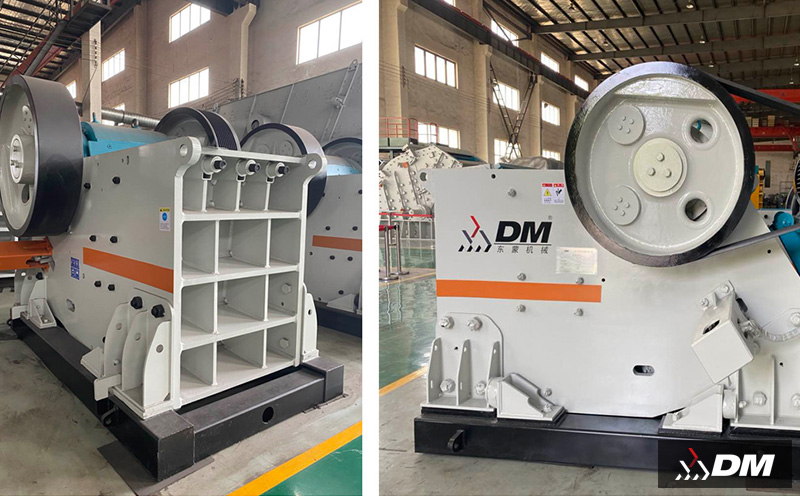
In scenarios such as mining, stone processing, and building demolition, you can often see large "iron-toothed" machines "biting" huge rocks into pieces one by one. This equipment is the jaw crusher, also commonly known as the "tiger mouth" in the industry. As the "first gate" of material crushing in modern industry, the jaw crusher is the most widely used primary crushing equipment worldwide.
1. Definition of Jaw Crusher
A jaw crusher is a crushing device used for coarse and medium crushing of materials of various hardnesses. It uses two jaw plates to exert extrusion, bending, and splitting forces on materials, breaking large rocks and ores into smaller, more manageable particles. It is suitable for crushing various ores and rocks with compressive strength not exceeding 320MPa, and is the main primary crushing equipment in concentrators and mining plants.
2. Origin of the Name: "Tiger Mouth"
The jaw crusher has a vivid nickname — "tiger mouth". This name comes from its working structure: the equipment consists of a fixed jaw plate and a movable jaw plate, which form a crushing chamber that is large at the top and small at the bottom, just like a tiger's open mouth. The movable jaw plate periodically approaches and leaves the fixed jaw plate, "biting" the materials entering the chamber into pieces like a tiger chewing food.
3. Core Structure: The "Skeleton and Teeth" of the Machine
A jaw crusher is mainly composed of the following core parts:
- Frame: The "skeleton" of the equipment, supporting all components, usually made of cast steel or welded structure
- Eccentric shaft: The core of power transmission, driving the movement of the movable jaw, is a key component of the equipment
- Large pulley and flywheel: Store energy, make the equipment run stably, and reduce power fluctuations
- Movable jaw and fixed jaw: The "teeth" of the equipment. The fixed jaw plate is vertically fixed on the front wall of the machine body, the movable jaw plate is inclined, and wear-resistant liners (jaw plates) are installed on the surfaces of both
- Toggle plate (thrust plate): Transmits power and plays an overload protection role. When uncrushable objects enter the equipment, the toggle plate breaks first to protect the main components
- Gap adjustment screw and return spring: Adjust the size of the discharge port to ensure the normal operation of the equipment
4. Working Principle: The Mystery of Crank Motion Extrusion
The working principle of a jaw crusher can be vividly understood as "simulating the jaw movement of animals". Its core is the crank motion extrusion crushing method, and the specific working process is as follows:
Power transmission: The motor drives the eccentric shaft to rotate through the pulley, transmitting the rotational power to the movable jaw.
Movable jaw movement: When the eccentric shaft rotates, it drives the movable jaw to make a reciprocating motion along a predetermined trajectory. When the movable jaw rises, it pushes the movable jaw plate close to the fixed jaw plate, and the materials entering the crushing chamber are subjected to multiple crushing actions such as extrusion, rubbing, and rolling; when the movable jaw descends, the movable jaw plate leaves the fixed jaw plate, and the crushed materials are discharged from the lower opening of the crushing chamber.
Continuous operation: With the continuous rotation of the motor, the movable jaw of the crusher performs periodic crushing and discharging, repeating the cycle to achieve continuous batch production.
5. Main Types
According to the movement characteristics of the movable jaw, jaw crushers are mainly divided into two types:
5.1 Simple Pendulum Type
The movable jaw is suspended on a spindle. When the eccentric shaft rotates, it pushes the movable jaw to swing left and right reciprocally through the connecting rod and thrust plate. All points on the movable jaw simply swing in an arc with the suspension shaft as the center. When this type of crusher works, the vertical displacement of the movable jaw is small, the over-crushing phenomenon during crushing is less, and the wear of the jaw plate by materials is relatively small.
5.2 Compound Pendulum Type
The movable jaw is directly suspended on the eccentric shaft and is directly driven by the eccentric shaft. The movement trajectory of each point on the movable jaw is different: the trajectory at the top is close to an arc, the middle part is an elliptical curve, and the ellipse becomes longer closer to the bottom. Under the same conditions, the production capacity of the compound pendulum jaw crusher is 20%-30% higher than that of the simple pendulum type, making it the most widely used type at present.
6. Performance Characteristics
The jaw crusher can become the most widely used primary crushing equipment in the world thanks to its unique performance advantages:
- Simple structure: Easy to maintain and use, low operating cost
- Large crushing ratio: Feed size can reach 1.5 meters, discharge size is adjustable, and finished product size is uniform
- Stable performance: Suitable for crushing large, medium and small stones, reliable in work
- Wear-resistant and durable: Jaw plates are made of high manganese steel, wear-resistant and compression-resistant, with long service life
- Strong adaptability: Can handle various hard materials from granite, basalt to iron ore, copper ore, etc.
- Energy-saving and environmental protection: Single machine saves 15%~30% energy, low noise and less dust
7. Main Application Fields
7.1 Mining and Metallurgy
In copper mines in Chile, iron ore mines in Australia, and gold mines in South Africa, jaw crushers are the "pioneers" in the mining process, initially crushing the mined raw ore to lay the foundation for subsequent medium and fine crushing and grinding processes.
7.2 Infrastructure Construction and Building Materials Production
From expressways in China to the Burj Khalifa in Dubai, high-quality aggregates are indispensable for concrete and asphalt, the core materials of modern buildings. Jaw crushers are widely used to crush parent rocks such as granite and limestone mined from quarries into crushed stones of different particle sizes to provide raw materials for various infrastructure projects.
7.3 Resource Recovery and Construction Waste Treatment
In urban renewal projects in Europe, the United States, and China, mobile or portable jaw crushers can be directly stationed at demolition sites to crush waste concrete and reuse it to produce recycled aggregates, realizing the resource utilization of construction waste.
8. Development History
The jaw crusher has a long history. In 1858, American E.W. Blake invented the world's first jaw crusher, which has a history of more than 160 years to date. After more than a century of development, jaw crushers have been continuously optimized in structural design, material selection, manufacturing processes, etc., but the core "crank motion extrusion" principle has remained unchanged. Today, modern jaw crushers have integrated intelligent technologies such as hydraulic adjustment, automatic control, wear-resistant material optimization, and remote monitoring, greatly improving operation efficiency and safety.
Conclusion
The jaw crusher, a "veteran" equipment born in the 19th century, still plays an irreplaceable role in the global industrialization process. With its simple structure, reliable work, and strong adaptability, it breaks hard rocks into pieces, paving the way for subsequent refined processing. Whether it is crushing huge rocks in mountain mines or recycling construction waste in cities, the jaw crusher, with its "iron teeth and copper jaws", is undoubtedly the cornerstone of modern material processing systems.
What are the Differences Between Cone Crusher and Jaw Crusher?
In fields such as mining, stone processing, and construction waste treatment, crushing equipment is the core of the entire production line. As two of the most common crushing equipment, cone crushers and jaw crushers often confuse investors: what are their differences? How to choose? This article will provide a detailed analysis from multiple dimensions to help you make an informed decision.
1. Different Core Positions: Coarse Crushing vs Medium & Fine Crushing
1.1 Jaw Crusher: "Pioneer" of Primary Crushing
Jaw crusher, commonly known as "jaw breaker" or "tiger mouth", is mainly used for primary coarse crushing of materials. It can handle various ores and large materials with compressive strength not exceeding 320MPa, and the feed size can reach more than 1.5 meters. In the entire production line, the jaw crusher usually plays the role of the "first gate", crushing mined huge rocks into medium-sized pieces to lay the foundation for subsequent processing.
1.2 Cone Crusher: "Finishing Expert" of Medium & Fine Crushing
Cone crusher is mainly used for medium and fine crushing of materials, suitable for crushing various ores and rocks with medium or higher hardness. It is usually located after the jaw crusher to further refine the coarsely crushed materials and produce finished aggregates that meet the particle size requirements. Cone crushers have large crushing ratio, high efficiency, low energy consumption, and uniform product size.
2. Differences in Working Principles
2.1 Jaw Crusher: Crank Motion Extrusion Type
The working principle of a jaw crusher can be vividly understood as "simulating the jaw movement of animals". Its core structure is a crushing chamber composed of a fixed jaw plate and a movable jaw plate, in a V-shape that is large at the top and small at the bottom. During operation, the motor drives the eccentric shaft to rotate through the pulley, driving the movable jaw plate to make periodic reciprocating motion relative to the fixed jaw plate.
- When approaching: Materials are crushed by the combined effects of extrusion, splitting, and bending fracture between the two jaw plates
- When leaving: Crushed materials are discharged from the discharge port under the action of gravity
2.2 Cone Crusher: Laminated Crushing Type
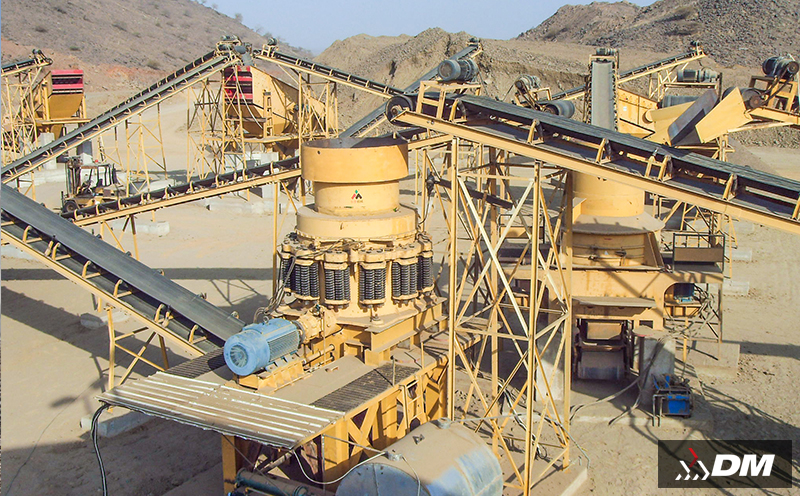
The working part of a cone crusher consists of two truncated cones — a fixed cone (outer cone) and a movable cone (inner cone). The movable cone is hinged on the main shaft, and its lower end is movably inserted into the eccentric bushing. When the eccentric sleeve rotates, the movable cone makes a swinging motion along the inner surface of the fixed cone.
- When approaching: Materials are subjected to multiple extrusions and impacts by the movable cone in the crushing chamber
- When moving away: Crushed materials are discharged from the bottom of the cone under their own weight
Cone crushers adopt the laminated crushing principle, where materials are not only subjected to extrusion but also interaction between particles, resulting in better finished product particle shape.
3. Comparison of Structural Characteristics
| Comparison Item | Jaw Crusher | Cone Crusher |
|---|---|---|
| Main Structure | Frame, fixed jaw plate, movable jaw plate, eccentric shaft, toggle plate, adjustment mechanism | Frame, transmission shaft, eccentric sleeve, spherical bearing, movable cone, adjustment device |
| Structural Complexity | Simple structure, easy to manufacture | Relatively complex structure with many precision components |
| Equipment Weight | Relatively light | 1.7-2 times heavier than jaw crusher of the same specification |
| Equipment Height | Relatively low | 2-3 times higher than jaw crusher, higher factory building construction cost |
4. Comparison of Performance Characteristics
4.1 Advantages of Jaw Crusher
- Simple structure: Easy to maintain and use, low operating cost
- Large crushing ratio: Large feed size, can handle huge rocks over 1.5 meters
- Price advantage: Relatively small initial investment, high cost performance
- Strong adaptability: Suitable for materials of various hardnesses, especially good at handling hard materials
- High reliability: Stable work, low failure rate
4.2 Disadvantages of Jaw Crusher
- Discontinuous work: Intermittent crushing, relatively low efficiency
- Discharge particle shape: High content of needle-like and flake-like particles, finished product shape is not as good as cone crusher
- High energy consumption: Unit power consumption is 0.5-1.2 times higher than cone crusher
- High foundation requirements: Foundation weight is 5-10 times the weight of the machine
4.3 Advantages of Cone Crusher
- High production efficiency: Continuous work, production capacity is more than twice that of jaw crusher of the same specification
- Low energy consumption: Unit power consumption is 0.5-1.2 times lower than jaw crusher
- Good finished product particle shape: Low content of needle-like and flake-like particles, high proportion of cubic particles
- Full-charge feeding available: No need to add ore bin and feeder
- Easy to start: Stable start-up, no auxiliary tools required
4.4 Disadvantages of Cone Crusher
- Expensive price: High initial investment cost
- Complex maintenance: Complex installation and maintenance, inconvenient inspection and repair
- Not suitable for wet materials: Easy to block when crushing wet and sticky ores
- Tall machine body: High factory building construction cost
5. Comparison of Applicable Materials
| Material Characteristics | Jaw Crusher | Cone Crusher |
|---|---|---|
| Applicable Hardness | Various hardnesses, compressive strength ≤320MPa | Medium hardness and above, best at hard rock |
| Applicable Material Types | Various ores, rocks, large materials | Hard rocks such as granite, basalt, river pebbles, metal ores, etc. |
| Wet and Sticky Materials | Can handle, but may block | Not suitable, easy to block |
| Flaky Materials | Can handle | Preferred choice, better effect |
6. Selection Suggestions: How to Choose?
6.1 Situations to Prioritize Jaw Crusher
- Primary crushing scenarios: The first process of the production line, handling large raw ore or rocks
- Small and medium-sized projects: Small production scale, sensitive to initial investment
- Material characteristics: Handling wet and sticky ores
- Underground crushing: Underground or space-constrained places
- Limited budget: Need to control initial equipment investment
6.2 Situations to Prioritize Cone Crusher
- Medium and fine crushing scenarios: Located after jaw crusher, need to further refine materials
- Large mines: Large processing capacity, need high efficiency and low energy consumption
- Hard rock crushing: High hardness materials such as granite, basalt, metal ores
- High quality requirements: Strict standards for finished product particle shape and needle-like/flaky content
- Slope terrain: Can use terrain advantages to arrange factory buildings
7. Common Matching Schemes
In actual production lines, jaw crushers and cone crushers are often partners rather than competitors. The most classic production line configuration is:
- First-stage crushing: Jaw crusher (coarse crushing)
- Second-stage crushing: Cone crusher (medium or fine crushing)
- Third-stage crushing: Cone crusher (fine crushing) or sand making machine
This "jaw crusher + cone crusher" combination gives full play to the advantages of both: the jaw crusher undertakes the coarse crushing of large materials, and the cone crusher is responsible for refined processing, jointly achieving efficient, energy-saving, and high-quality crushing operations.
Conclusion
Jaw crushers and cone crushers each have their own strengths, and there is no absolute "which is better", only "which is more suitable". With its simple structure, affordable price, and ability to "chew hard bones", the jaw crusher is the best choice for the coarse crushing stage; the cone crusher, with its advantages of high efficiency, low consumption, and excellent particle shape, dominates the medium and fine crushing field.
Shanghai Dongmeng Road & Bridge Machinery Co., Ltd. provides a full range of jaw crushers, cone crushers, and crawler mobile crushing stations to meet the diverse needs of global customers. Whether you are building a large mine or a small quarry, we can tailor the optimal crushing solution for you. Welcome to consult at any time to get professional selection suggestions!












We will answer your email shortly!