


In engineering fields such as mine development, sand and gravel production, and construction waste resource utilization, the selection between jaw crushers and impact crushers is essentially the precise matching of "engineering needs and equipment functions". The two are not alternative relationships based on "advanced or not", but functional differentiated products based on "raw material processing goals", "finished product application scenarios", and "project operation modes". Breaking away from traditional parameter comparisons, this article analyzes their functional positioning differences from the original design intention of the equipment, providing practical ideas for "demand-function" matching in engineering selection.
I. Design Intention: Functional Differentiation to Solve Different Engineering Pain Points
Jaw Crusher: The core design is to solve the engineering pain point that "extra-large raw materials cannot enter subsequent processes". In scenarios such as mine mining and construction waste demolition, the particle size of raw materials often reaches 1-2 meters, which cannot be directly processed by ordinary equipment. Through the structural design of "wide feed opening + strong static pressure crushing", jaw crushers become exclusive equipment for the "first checkpoint" of the production line. Its design priority is "compressive strength > processing efficiency > operational stability". Even under harsh working conditions such as -20℃ low temperature and high dust, it can still ensure continuous operation. The core goal is to "convert unusable large raw materials into processable medium-grain materials".
Impact Crusher: The core design is to solve the engineering pain point that "the quality of finished products from ordinary crushing equipment is not up to standard". With the continuous improvement of requirements for aggregate particle shape and gradation in high-grade concrete and high-quality road projects, the "needle-like and flaky aggregates" produced by traditional crushing equipment can no longer meet the demand. Through the structural design of "high-speed kinetic energy impact + multi-directional collision shaping", impact crushers integrate "crushing" and "shaping" functions. Its design priority is "particle shape optimization > gradation uniformity > finished product purity", and the core goal is to "convert ordinary aggregates into high-value-added high-quality aggregates or mechanical sand".
II. Functional Characteristics: Differentiated Performance of Core Capabilities
Jaw Crusher: The core capability is "heavy-load primary crushing". Its crushing cavity adopts a "V-shaped structure", and the movable jaw plate has a large stroke (10-20mm), which can exert continuous static pressure on large materials. The crushing ratio is stably maintained at 10-25, and it can process various hard rocks and wastes with compressive strength ≤ 350MPa. The equipment structure adopts "integral cast steel frame + eccentric shaft transmission" without complex wearing parts, and the failure rate is less than 0.5% per thousand hours, suitable for 24-hour continuous operation. It is especially suitable for engineering scenarios with "unstable raw material supply and high impurity content", such as open-pit mine primary crushing and front-end processing of construction waste centralized treatment plants.
Impact Crusher: The core capability is "precision crushing + shaping". Its crushing cavity adopts a "multi-stage impact structure", and the rotor linear speed can reach 40-60m/s. After being hit by the hammer, the material will form multiple collisions between the impact plate and the material layer. The content of needle-like and flaky particles can be controlled at 3%-5%, and the particle gradation meets the requirement of "continuous gradation". The equipment is equipped with a "frequency conversion speed regulation + hydraulic adjustment" system, which can flexibly switch between "sand making mode" and "aggregate shaping mode" by adjusting the rotor speed (1500-3000r/min) and impact plate gap (5-50mm). It is suitable for engineering scenarios with "high requirements for finished product quality and flexible production schemes", such as commercial concrete mixing stations and high-quality aggregate production lines.
III. Engineering Demand Adaptation Priority: Selection Logic for Different Scenarios
1. Priority of raw material processing goals:
- If the goal is "rapid volume reduction and reduction of transportation/processing costs" (such as temporary crushing at construction waste demolition sites and primary crushing of mine raw stones), prioritize jaw crushers. Its "large feed opening + high processing efficiency" can quickly solve the problem that "raw materials cannot be transported or enter subsequent equipment";
- If the goal is "improving the added value of finished products and meeting high-end engineering requirements" (such as production of high-grade concrete aggregates and mechanical sand preparation), prioritize impact crushers. Its integrated "crushing + shaping" function can directly produce qualified finished products, reducing secondary processing links.
2. Priority of finished product application scenarios:
- If the finished products are used in low-demand scenarios such as "roadbed filling, foundation pit backfilling, and low-grade concrete", select jaw crushers. There is no need for additional investment in shaping equipment, which controls project costs;
- If the finished products are used in high-end scenarios such as "high-grade concrete, road surface layers, and ready-mixed mortar", impact crushers must be selected. The particle shape and gradation of its finished products can ensure project quality and avoid engineering hazards caused by substandard aggregate quality.
3. Priority of project operation modes:
- If the project is "short-term leasing and temporary operation" (such as on-site crushing of rocks in infrastructure project foundation pits and temporary volume reduction of waste at demolition sites), select jaw crushers. The equipment has low leasing costs and simple maintenance, adapting to short-term high-intensity operations;
- If the project is "long-term operation and large-scale production" (such as annual output of 1 million tons of high-quality aggregate plants and construction waste resource utilization factories), select impact crushers or the "jaw crusher + impact crusher" combination. High-value-added finished products can improve the long-term benefits of the project and recover the equipment investment cost.
IV. Avoidance of Typical Selection Misunderstandings: Prevention of Functional Mismatch
1. Misunderstanding 1: Using jaw crushers to produce high-quality aggregates——The content of needle-like and flaky particles in jaw crusher finished products is high (15%-25%). Even with subsequent screening equipment, it cannot meet the requirements of high-end projects. Instead, it increases equipment investment. It is recommended to match impact crushers for secondary shaping;
2. Misunderstanding 2: Using impact crushers to directly process large high-hardness raw materials——The feed particle size of impact crushers is limited to ≤ 300mm, and their wear resistance to high-hardness (≥ 7 Mohs) raw materials is poor. The service life of hammers will be shortened by more than 50%. It is recommended to match jaw crushers for primary crushing at the front end;
3. Misunderstanding 3: Ignoring differences in operation and maintenance costs——The operation and maintenance cost of jaw crushers (1.2-2.5 yuan/ton) is lower than that of impact crushers (2.0-4.5 yuan/ton), but the selling price of impact crusher finished products can be 30%-50% higher. It is necessary to comprehensively calculate the return on investment based on the sales volume and selling price of finished products, rather than simply pursuing low operation and maintenance costs.
V. Optimized Combination Configuration Scheme: Maximizing Engineering Benefits
In large-scale production projects, the combined configuration of "jaw crusher + impact crusher" is the optimal choice. Its core logic is "division of labor and complementary advantages":
- Front end: Jaw crushers are responsible for "primary crushing and volume reduction", crushing large raw materials (1-1.5m) into 50-100mm coarse aggregates, solving the problem that "raw materials are too large to be processed";
- Middle end: Impact crushers are responsible for "fine crushing and shaping", processing coarse aggregates into 5-30mm high-quality aggregates or 0.15-5mm mechanical sand, improving the quality and added value of finished products;
- Back end: Equipped with screening equipment and sand washing equipment to achieve classification and purification of finished products, meeting the differentiated needs of different engineering scenarios.
For example, a construction waste recycled aggregate project with an annual output of 1.5 million tons adopts the combination of "mobile jaw crusher + mobile impact crusher + screening station". Jaw crushers process large waste, impact crushers process high-quality aggregates, the qualified rate of finished products reaches 98%, and the selling price per ton is 60 yuan higher than that processed by a single jaw crusher. The project investment recovery period is shortened to 18 months.
VI. Summary
The functional positioning differences between jaw crushers and impact crushers are essentially the division of labor between "front-end primary crushing and volume reduction" and "middle-end precision processing" in engineering. Jaw crushers are "entry-level equipment for engineering raw material processing", solving the basic problem of "raw materials being usable"; impact crushers are "core equipment for improving finished product quality", solving the advanced problem of "raw materials being easy to use and valuable".
The core of selection does not lie in "the level of equipment parameters", but in "the matching degree between engineering needs and equipment functions": for short-term temporary operations and low-requirement finished products, select jaw crushers; for long-term large-scale production and high-requirement finished products, select impact crushers or combined configurations. Only by accurately matching needs can we achieve a balance between engineering efficiency, cost control and maximum benefits.
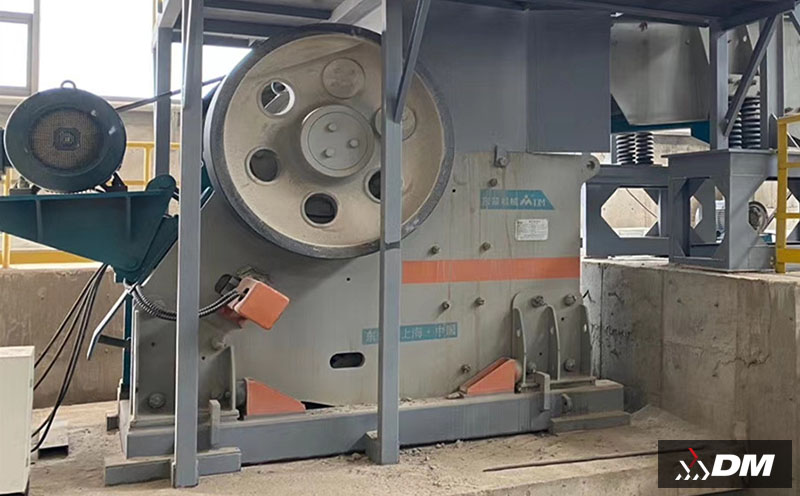
Construction Waste Crushing: Functional Adaptation and Scenario-Based Selection of Jaw Crushers and Impact Crushers
The core contradiction in the resource utilization of construction waste is the conflict between "raw material complexity" and "finished product standardization". The selection of jaw crushers and impact crushers directly determines the efficiency of solving this contradiction. The functional adaptability of the two in construction waste treatment is reflected in the differentiated performance in three scenarios: "raw material pretreatment", "finished product processing", and "operation cost". Combined with the characteristics of construction waste—"uneven particle size, complex composition, and high demand for added value"—this article analyzes the differences in their functional adaptation and provides scenario-based selection schemes.
I. Raw Material Pretreatment Scenario: Primary Crushing & Volume Reduction vs. Processing After Precision Sorting
Jaw Crusher: Suitable for the scenario of "primary crushing of unsorted construction waste". After demolition, construction waste is often mixed with impurities such as steel bars, wood blocks, concrete blocks, and rocks, with a particle size of up to 1-1.2m. Jaw crushers have a wide feed opening (300-1500mm) and high compressive strength (≤ 350MPa), and can directly process unsorted raw materials without prior manual sorting (only need to remove extra-large metals and wood). They are not easy to jam during the crushing process, and can quickly reduce large waste into 50-300mm coarse aggregates, reducing subsequent transportation and processing costs. They are the preferred equipment for temporary crushing at construction waste centralized treatment plants and demolition sites.
Impact Crusher: Suitable for the scenario of "precision processing of sorted construction waste". For construction waste that has undergone primary crushing by jaw crushers or manual sorting (removal of metals and large impurities, particle size ≤ 300mm), impact crushers can peel off the cement mortar on the surface of aggregates and optimize the particle shape through "impact + collision" to produce recycled aggregates that meet GB/T 25177-2010 standards. Directly processing unsorted construction waste will lead to accelerated wear of hammers (service life shortened to 2000-3000h) and frequent equipment failures. Therefore, it is necessary to match pretreatment links, adapting to the precision processing production lines of construction waste resource utilization factories.
II. Finished Product Processing Scenario: Low-Value-Added vs. High-Value-Added Output
Jaw Crusher: Produces "low-value-added coarse aggregates", mainly used in low-requirement scenarios such as roadbed filling, temporary road paving, and foundation pit backfilling. The finished products have irregular particle shapes, with a needle-like and flaky particle content of 15%-25% and a crushing value of 18%-25%, which cannot meet the requirements of concrete aggregates. However, the processing cost is low (1.5-2.8 yuan/ton), suitable for projects "focused on volume reduction with low requirements for finished products", such as temporary treatment of demolition waste in urban village reconstruction and on-site waste backfilling in infrastructure projects.
Impact Crusher: Produces "high-value-added high-quality aggregates/mechanical sand", which can be directly used in high-end scenarios such as concrete mixing, brick making, and road surface layers. The finished products have a cubical particle shape, with a needle-like and flaky particle content ≤ 5% and a crushing value ≤ 16%, meeting the first-class standard for recycled aggregates. The selling price is 30%-50% higher than that of ordinary coarse aggregates (about 100-200 yuan/ton), suitable for projects "focused on resource utilization and pursuing high benefits", such as construction waste recycled aggregate factories and supporting processing lines of commercial concrete mixing stations.
III. Balance Between Operation Cost and Benefit: Short-Term Cost vs. Long-Term Benefit
Jaw Crusher: Has significant advantages in short-term operation costs. The equipment purchase/lease cost is low (about 50%-70% of that of impact crushers). The wearing parts are jaw plates (high manganese steel material, service life 8000-12000h) with low replacement costs, and the daily maintenance time is ≤ 1 hour, suitable for projects with limited budgets and short-term operations. However, the added value of finished products is low, and the long-term benefits are limited, which can only cover equipment operation costs and labor costs.
Impact Crusher: Has outstanding advantages in long-term benefits. Although the equipment purchase/lease cost is high, and the wearing parts are hammers/impact plates (wear-resistant alloy material, service life 3000-8000h) with operation and maintenance costs 30%-50% higher than those of jaw crushers, the high-value-added finished products can bring continuous and stable high benefits. Taking a recycled aggregate project with an annual output of 1 million tons as an example, the high-quality aggregates processed by impact crushers generate 40-60 million yuan more profit per year than ordinary aggregates processed by jaw crushers, which can quickly recover the additional investment in equipment.
IV. Core Scenario-Based Selection Schemes
1. Temporary treatment scenario at demolition sites: Select mobile jaw crushers. No fixed site is required, and on-site crushing and volume reduction can be carried out to reduce transportation costs. The equipment can be flexibly transferred to adapt to multiple demolition projects, with simple operation and maintenance, meeting the needs of short-term high-intensity operations;
2. Construction waste centralized treatment plant scenario: Select the combination of "fixed jaw crusher + mobile impact crusher". Jaw crushers are responsible for front-end primary crushing and volume reduction, and impact crushers are responsible for middle-end precision processing, balancing processing efficiency and finished product quality. Suitable for large-scale and long-term operations, and can flexibly switch finished product specifications according to market demand;
3. Small-scale resource utilization project scenario (hourly output ≤ 50 tons): If only filling materials need to be produced, use jaw crushers alone; if qualified recycled aggregates need to be produced, select small impact crushers with simple screening equipment to control initial investment and meet the needs of small-scale projects in the region;
4. Large-scale resource utilization project scenario (hourly output ≥ 100 tons): Must select a complete production line of "jaw crusher + impact crusher + screening + sand washing". Jaw crushers ensure raw material processing efficiency, impact crushers ensure finished product quality, and subsequent equipment improve finished product purity, realizing "full resource utilization and high-value utilization" of construction waste and maximizing project benefits.
V. Summary
In construction waste treatment, jaw crushers are basic equipment for "solving raw material processing problems", with core values of "rapid volume reduction and cost reduction"; impact crushers are core equipment for "improving project benefits", with core values of "finished product quality improvement and added value increase". During selection, comprehensive judgment should be made based on project scenarios (temporary/long-term, small-scale/large-scale), finished product requirements (low/high requirements), and budget costs (limited/sufficient) to avoid functional mismatch. For projects pursuing maximum resource utilization efficiency and benefits, the combined mode of "jaw crusher primary crushing + impact crusher precision processing" can perfectly adapt to the characteristics of construction waste, realizing a virtuous cycle of "low-cost processing + high-benefit output", which is the mainstream and optimal scheme for current construction waste resource utilization.













We will answer your email shortly!